Interview · Issue 001 · pp. 060–067 · 11 min read
Aliina Kauranne
- Interview / Joni Lindroos
- Illustrations / Aliina Kauranne
This story in print
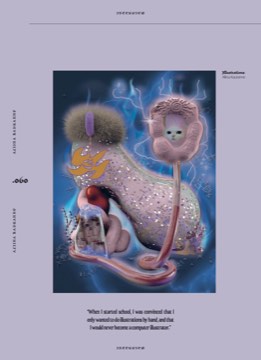
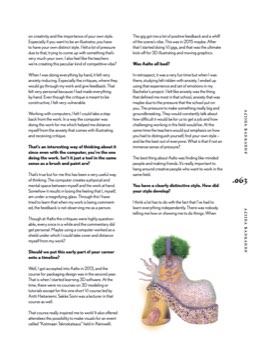
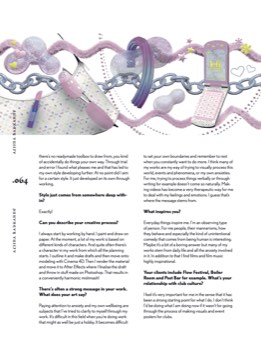
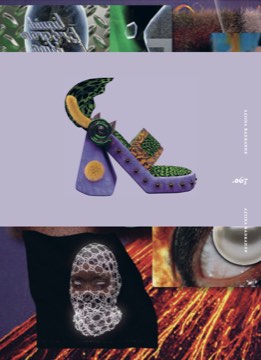
“When I started school, I was convinced that I only wanted to do illustrations by hand, and that I would never become a computer illustrator.”
Aliina Kauranne is an Illustrator and Graphic Designer from Hausjärvi, who moved to Helsinki to study at Aalto University. Little did she know that by now she would have two Kultahuippu awards, an Illustrator of the year-title under her belt, and a bright future ahead.
How did you get started?
I applied to Aalto University of Arts, Design and Architecture to study graphic design because illustration is something that has always interested me. Our career counsellors at school told me it made no sense to apply since no one gets in. I really didn’t have anything else in mind either so I applied anyway. I got in.
That’s rough! Have you talked to your career counsellors after that?
No. I went to high school in Hyvinkää and haven’t really visited after graduation. Maybe the role of high school career counsellors isn’t to encourage you to go after your dreams? Maybe they are there to remind you of the more “sensible” options.
Revenge is sweet though. How was Aalto?
When I started, I felt like I wanted to do illustration and I didn’t actually know about anything else. I wasn’t aware what graphic design was and what it could entail but it soon revealed itself to be a really vast entity consisting of all sorts of things. Through that I’ve ended working with 3D illustrations and animation. It all came together by accident, kind of.
What kind of an accident?
When I started school, I was convinced that I only wanted to do illustrations by hand, and that I would never become a computer illustrator. Coincidentally, I chose package design as my minor subject and we had a week-long 3D modeling course. At that point I was still thinking to myself, oh my god, what is all this computer work? It felt very strange and super difficult. But at the same time I felt there was something intriguing about it.
Why did you think negatively of computer-driven design?
Initially, it just felt soulless and empty! All the 3D graphics or digital illustrations that I had seen prior were all very similar to each other. And the computer didn’t feel like the right tool for me. Instead, I wanted to do everything by hand using traditional, more manual, methods.
When we started doing 3D modeling during the course, I immediately got excited about the software. To me, it felt technical, new, confusing and so different. I felt like I wanted to learn to master it!
Did it feel good finding your own thing?
I do believe that the only way to success is by doing your own thing. At Aalto they put a lot of emphasis on creativity and the importance of your own style. Especially if you want to be an illustrator, you have to have your own distinct style. I felt a lot of pressure due to that, trying to come up with something that’s very much your own. I also feel like the teachers we’re creating this peculiar kind of competitive vibe?
When I was doing everything by hand, it felt very anxiety-inducing. Especially the critiques, where they would go through my work and give feedback. That felt very personal because I had made everything by hand. Even though the critique is meant to be constructive, I felt very vulnerable.
Working with computers, I felt I could take a step back from the work. In a way the computer was doing the work for me which helped me distance myself from the anxiety that comes with illustrating and receiving critique.
That’s an interesting way of thinking about it since even with the computer, you’re the one doing the work. Isn’t it just a tool in the same sense as a brush and paint are?
That’s true but for me this has been a very useful way of thinking. The computer creates a physical and mental space between myself and the work at hand. Somehow it results in losing the feeling that I, myself, am under a magnifying glass. Through this I have tried to learn that when my work is being commented, the feedback is not observing me as a person.
Though at Aalto the critiques were highly questionable, every once in a while and the commentary did get personal. Maybe using a computer worked as a shield under which I could take cover and distance myself from my work?
Should we put this early part of your career onto a timeline?
Well, I got accepted into Aalto in 2013, and the course for packaging design was in the second year. That is when I started learning 3D software. At the time, there were no courses on 3D modeling or tutorials except for this one short VJ course led by Antti Hietaniemi. Sakke Soini was a lecturer in that course as well.
That course really inspired me to work! It also offered attendees the possibility to make visuals for an event called “Kotimaan Teknokatsaus” held in Ääniwalli. The gig got me a lot of positive feedback and a whiff of the scene’s vibe. This was in 2015 maybe. After that I started doing VJ gigs, and that was the ultimate kick-off for 3D illustrating and moving graphics.
Was Aalto all bad?
In retrospect, it was a very fun time but when I was there, studying felt ridden with anxiety. I ended up using that experience and set of emotions in my Bachelor’s project. I felt like anxiety was the thing that defined me most in that school, anxiety that was maybe due to the pressure that the school put on you. The pressure to make something really big and groundbreaking. They would constantly talk about how difficult it would be for us to get a job and how challenging working in this field would be. At the same time the teachers would put emphasis on how you had to distinguish yourself, find your own style – and be the best out of everyone. What is that if not an immense sense of pressure?
The best thing about Aalto was finding like-minded people and making friends. It’s really important to hang around creative people who want to work in the same field.
You have a clearly distinctive style. How did your style develop?
I think a lot has to do with the fact that I’ve had to learn everything independently. There was nobody telling me how or showing me to do things. When there’s no readymade toolbox to draw from, you kind of accidentally do things your own way. Through trial and error I found what pleases me and that has led to my own style developing further. At no point did I aim for a certain style. It just developed on its own through working.
Style just comes from somewhere deep within?
Exactly!
Can you describe your creative process?
I always start by working by hand. I paint and draw on paper. At the moment, a lot of my work is based on different kinds of characters. And quite often there’s a character in my work from which all the planning starts. I outline it and make drafts and then move onto modeling with Cinema 4D. Then I render the material and move it to After Effects where I finalise the draft and throw in stuff made on Photoshop. That results in a conveniently harmonic mishmash!
There’s often a strong message in your work. What does your art say?
Paying attention to anxiety and my own wellbeing are subjects that I’ve tried to clarify to myself through my work. It’s difficult in this field when you’re doing work that might as well be just a hobby. It becomes difficult to set your own boundaries and remember to rest when you constantly want to do more. I think many of my works are my way of trying to visually process this world, events and phenomena, or my own anxieties. For me, trying to process things verbally or through writing for example doesn’t come so naturally. Making videos has become a very therapeutic way for me to deal with my feelings and emotions. I guess that’s where the message stems from.
What inspires you?
Everyday things inspire me. I’m an observing type of person. For me people, their mannerisms, how they behave and especially the kind of unintentional comedy that comes from being human is interesting. Maybe it’s a bit of a boring answer but many of my works stem from daily life and all the anxiety involved in it. In addition to that I find films and film music highly inspirational.
Your clients include Flow Festival, Boiler Room and Post Bar for example. What’s your relationship with club culture?
I feel it’s very important for me in the sense that it has been a strong starting point for what I do. I don’t think I’d be doing what I am doing now if it wasn’t for going through the process of making visuals and event posters for clubs.
At the moment it’s on the back burner a bit however, because I haven’t really been doing any visuals at all due to lack of time. It’s now more of a hobby. But I would like to make more music videos and I think that the music scene and clubbing are things that’ll always be close to my heart.
It feels like Helsinki’s vibrant club culture, visuals at events and posters for clubs have been important for many illustrators and graphic designers.
Absolutely.
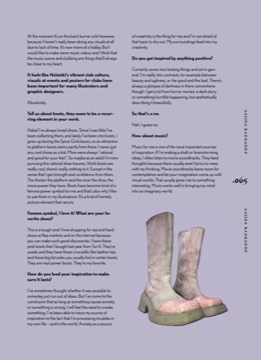
Tell us about boots, they seem to be a recurring element in your work.
Haha! I’ve always loved shoes. Since I was little I’ve been collecting them, and lately I’ve been into boots. I grew up during the Spice Girls boom, so an attraction to platform boots stems partly from there. I never got any cool shoes as a kid. Mine were always “rational and good for your feet”. So maybe as an adult I’m now pursuing this rational shoe trauma. I think boots are really cool, there’s really nothing to it. Except in the sense that I get strength and confidence from them. The thicker the platform and the nicer the shoe, the more power they have. Boots have become kind of a femme power symbol for me and that’s also why I like to use them in my illustrations. It’s a kind of homely picture element that recurs.
Femme symbol, I love it! What are your favorite shoes?
This is a tough one! I love shopping for second hand shoes at flea markets and on the internet because you can make such good discoveries. I have these pink boots that I bought last year from Tori.fi . They’re suede and they have these crocodile-like leather tips and those big fat soles you usually find in winter boots. They are real power boots. They’re my favorite.
How do you feed your inspiration to make sure it lasts?
I’ve sometimes thought whether it was possible to someday just run out of ideas. But I’ve come to the conclusion that as long as something causes anxiety or something is wrong, I will feel the need to create something. I’ve been able to trace my source of inspiration to the fact that I’m processing troubles in my own life – and in the world. Anxiety as a source of creativity is the thing for me and I’m not afraid of that topic to dry out. My surroundings feed into my creativity.
Do you get inspired by anything positive?
Certainly some nice looking things and art in general. I’m really into contrasts, for example between beauty and ugliness, or the good and the bad. There’s always a glimpse of darkness in there somewhere though. I get a lot from horror movies: a dark story or something horrible happening, but aesthetically describing it beautifully.
So that’s a no.
Hah. I guess so.
How about music?
Music for me is one of the most important sources of inspiration. If I’m making a draft or brainstorming ideas, I often listen to movie soundtracks. They feed thoughts because there usually aren’t lyrics to mess with my thinking. Movie soundtracks leave room for contemplation and let your imagination come up with visual worlds. That usually gives rise to something interesting. Music works well in bringing my mind into an imaginary world.
What is your go-to soundtrack when trying to come up with ideas?
Definitely the soundtrack to Dario Argento’s Suspiria.
What is art to you?
Art for me is something that generates new thoughts, inspires and surprises. For me, the most satisfying art isn’t necessarily such that it only sparks good feelings, but rather something that’s a bit disturbing, or unpleasant in a way that sticks in your mind. Maybe that’s my definition for art. I don’t require anything grande: colossal gallery spaces or the like. It’s enough for me that works speak to me and make me think. Possibly also change my world view?
That’s a good definition and it portrays the fact that you’re an artist yourself, for whom art is a way of creating things that fulfill. Do you have any dreams?
An obvious one for me is to make longer animation pieces. That’s perhaps the only concrete dream I want to achieve. It’s achievable. Other than that I don’t have any distinct dreams. Of course making progress in doing your own thing but I also don’t want to define my process too much. I’m open to anything, let’s see what comes my way.
Nice. How was your summer?
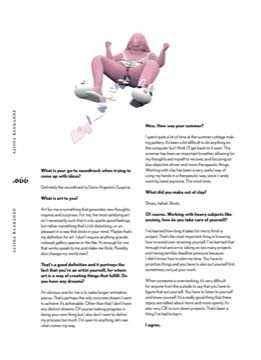
I spent quite a lot of time at the summer cottage making pottery. It’s been a bit difficult to do anything on the computer but I think I’ll get back to it soon. This summer has been an important breather, allowing for my thoughts and myself to recover, and focusing on less objective-driven and more therapeutic things. Working with clay has been a very useful way of using my hands in a therapeutic way, since I rarely work by hand anymore. The mind rests.
What did you make out of clay?
Shoes, hahah. Boots.
Of course. Working with heavy subjects like anxiety, how do you take care of yourself?
I’ve learned how long it takes for me to finish a project. That’s the most important thing in knowing how to avoid over-straining yourself. I’ve learned that through trial and error, taking on too many projects and having terrible deadline pressure because I didn’t know how to plan my time. You have to prioritize things and you have to also put yourself first sometimes, not just your work.
When someone is overworking, it’s very difficult for anyone from the outside to say that you have to figure that out yourself. You have to listen to yourself and know yourself. It’s a really good thing that these topics are talked about more and more openly. It’s also very OK to turn down projects. That’s been a thing I’ve had to learn.
I agree.
Next in Issue 001: Commercial art?