Interview · Issue 001 · pp. 024–033 · 16 min read
Landys Roimola
- Interview / Juho Vesanen
- Photography / Pietari Purovaara
- Stylist / Sanna Silander
- Make-up & hair / Jennifer Appleton
- Outfit / Marine Serre
- Jewelry / Reea Winter
- Thank you / CM-44
This story in print
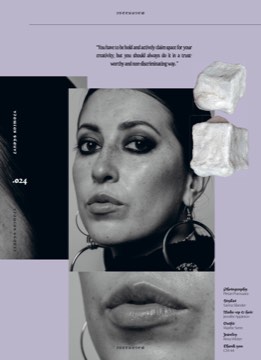
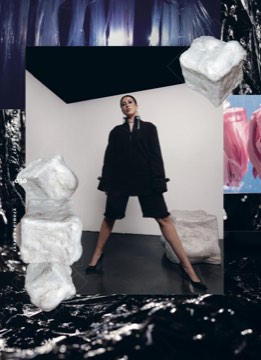
“You have to be bold and actively claim space for your creativity, but you should always do it in a trustworthy and non-discriminating way.”
Landys Roimola is a visual artist born in Bogota, Colombia in 1992. Landys was adopted by a Finnish couple and grew up in Lappeenranta, a small city in Eastern Finland. Landys has found a place in the world of art and activism, despite what could be described as a slightly unorthodox upbringing. The artist’s large-scale installations study the relationship between humans and our planet, often by utilizing materials that people have thrown away. Landys is a curious observer of the world who draws inspiration from the everyday within the global context. As she puts it: “The role of an artist is to inspire and encourage people in the face of major global crises.”
What was growing up in Lappeenranta like?
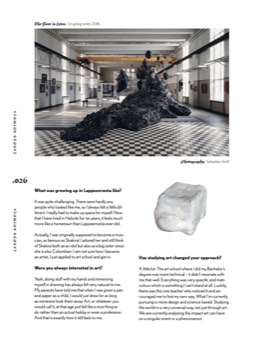
It was quite challenging. There were hardly any people who looked like me, so I always felt a little different. I really had to make up space for myself. Now that I have lived in Helsinki for six years, it feels much more like a hometown than Lappeenranta ever did.
Actually, I was originally supposed to become a musician, as famous as Shakira! I adored her and still think of Shakira both as an idol but also as a big sister since she is also Colombian. I am not sure how I became an artist, I just applied to art school and got in.
Were you always interested in art?
Yeah, doing stuff with my hands and immersing myself in drawing has always felt very natural to me. My parents have told me that when I was given a pen and paper as a child, I would just draw for as long as someone took them away. Art, or whatever you would call it, at that age just felt like a nice thing to do rather than an actual hobby or even a profession. And that is exactly how it still feels to me.
Has studying art changed your approach?
A little bit. The art school where I did my Bachelor’s degree was more technical – it didn’t resonate with me that well. Everything was very specific and meticulous which is something I can’t stand at all. Luckily, there was this one teacher who noticed it and encouraged me to find my own way. What I’m currently pursuing is more design and science-based. Studying the world in a very universal way, not just through art. We are currently analyzing the impact art can have on a singular event or a phenomenon.
What does creativity mean to you?
This is actually a really interesting topic and we’ve talked about it a lot in school lately. We’ve analyzed how one can become creative and what tools one should use to be able to be creative. This has felt very strange to me since creativity has always been a natural state of mind for me. I’ve never had this “blank page” syndrome. Creativity in my opinion is a muscle that has to just be used, not that much a talent or feature that some people have and others don’t. I do consider myself creative though. Creativity is a lot about problem solving. It is the ability to piece the bits and pieces together that result in creativity rather than someone being really good in any single skill. I’m often asked if I can draw since I’m a visual artist. And I’m like yes I can draw, but that is not the thing that matters, but rather how and in what context I choose to use that tool.
So being really talented in a single skill doesn’t make you creative by definition, but it is essential in the journey of becoming one?
Exactly so.
You use waste and recycled stuff almost exclusively as your source material in your artworks, why?
It started with me being a poor student and I didn’t have any money for proper materials (laughs). I’ve always been very ideological in my thinking and I don’t want to produce new waste with my art. Especially considering the scale of my pieces, which are pretty big, I wouldn’t be able to look at myself in the mirror if I made them out of new plastic. Waste is also a really personal thing for people and you can learn a lot from it. Almost all waste has been valuable to someone before it was thrown away, and then it just loses all of it’s value. I, on the other hand, make it valuable again which fascinates me a lot.
Most of your works are installations, is the experimental nature of art important to you?
Yes definitely! I’m also interested in questioning art in terms of its place, meaning that art does not necessarily have to be on the walls of museums or galleries but rather somewhere where people can touch them and go inside them for example. I love to touch things wherever I go so that aspect is definitely present in my art. I’m really into haptics and the immersive nature of installations.
Does art always have to have a message or a deeper meaning?
It would seem really pointless to me to be an artist in this world and not say anything. The art that I find interesting is seldom “just” visually beautiful, but rather has a clear point of view or a meaning. I feel that artists should be in the forefront of visualizing and interpreting the current social and environmental phenomenons that we are facing everyday. It is really hard for me to imagine that an art piece that expresses nothing could be touching in any way. On the other hand, not saying anything is also a way of saying something – maybe art always has a message.
Can that also be distressing for an artist who isn’t that ideological?
It can be, but for me it comes very naturally. I was eight years old when I realized that paper is made of trees and I started crying to my mom as animals live on trees. Activism and a general awareness of things is something that comes naturally to all of us on a subconscious level. We all live on the same planet and mirror the things happening in our society in our behaviour. Some of us are just more active in communicating it outwards.
Yes, art is and has always been a portrayal of the period, even if it doesn’t try to be. Can you tell me a little bit about your process. How did you pursue the Goo project?
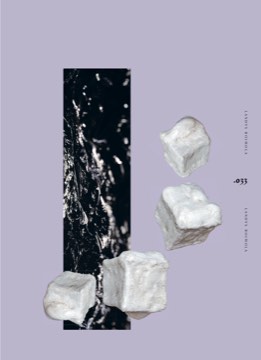
Goo was something that I really wanted to do for Flow Festival. I approached them saying that you need this (laughs). They were really open to my idea and asked me to tell them more about it, although at this point I really didn’t have a precise plan yet. I got a truckload of packaging plastic to use as source material, which was great. I had never used this kind of plastic before so a lot of googling took place. I also received a lot of help from people willing to help. Once I figured out the limits of the material, I made a square mold which I used to form the individual pieces that I then arranged as the final installation. After the festival all the pieces were sold so the waste transformed into something that has value and use.
What about the Norsu project you did for Provinssi? The idea behind it was that the installation weighs as much as the waste two Finns produce in a year. How important is it to communicate the backstory of your work?
It is really important. Also the festival setting at Provinssi was perfect for this kind of installation since the demographic of that festival is so wide and you can reach a lot of people who wouldn’t normally visit museums or be interested in art. I got the material from a local waste management company and the whole installation was recycled afterwards, so I just basically loaned the material from them. The festival also received an “Eco-compass certificate” thanks to the visual arts presented.
So the viewer’s experience is significantly deeper when the motive and meaning is explained, but the piece doesn’t require that information to be able to attract interest in the first place?
If a work of art does not get your attention, then you won’t even go closer to learn more about it. It’s quite similar to being attracted to someone. First, you notice the visual characteristics and after that you get to know the person.
What do you think about artificial intelligence art, where there is no artist but an algorithm makes art based on the source material it has been given?
If there is no artist, then there is no one who would have ever felt anything and for me art is totally dependent on emotion and emotional intelligence. But at the same time, I have a hard time saying that something isn’t art.
One big topic in AI art is to challenge the viewers perception of art, when there is no artist and no motive. Do you experience art differently when there is no artist, it asks.
In a way, this comes back to art being a portrayal of a period. Art and the discussion around it change in regards to current technology and social situations, as it has always done. But is AI art considered art because it’s a novelty at the moment? If there were 300 algorithms creating art, would it still be interesting to us?
That’s a good point. The art field was quite shocked a couple of years ago when Christie’s sold a painting that was made by an algorithm that the art collective Obvious created. This made AI art somehow official in the art world.
Who was paid for the painting?
The Obvious collective, apparently?
So there basically was an artist who created the algorithm.
Kind of. Maybe someday that human contact can no longer be traced, it will get more complicated as algorithms teach other algorithms and so on.
Exactly and going back to what I said earlier, I don’t feel that being an artist is my profession as much as it being just an essential part of my life. That is a really difficult thing for artificial intelligence to replace.
When comparing your commissioned and personal work, is there a big difference? You show them quite mixed in your portfolio.
I’d say that my personal work is a bit more aggressive and dark than my commissioned work. But since I don’t have a single very recognizable technique or element in my work, they mix quite nicely. I also feel very privileged in a way because people know my values and way of working quite well. I’m commissioned to do projects that are very aligned with my artistry. Obviously the biggest way the two differ from each other is that when you are commissioned to do something, you are also obliged to listen and respect the commissioners wishes.
It could also be described as being a professional. You are interpreting the client’s wishes and goals in your art. Can commissioned work become your best work?
I think so, but it hasn’t happened yet. For that to happen, the client needs to have a crystal clear vision and we’d need to be very aligned with our values. The problem is often that those things can happen on an individual level, but when working with big companies the hierarchy of the organisation can be too complex. It is very easy to lose the “why” when most of the energy goes into the “how” and “when”. It takes a lot to make something that stands the test of time.
I think the client or the commissioner is often quite underrated in the process of art at least on the scale that you work with.
I agree. Particularly as my work is always based on collaboration because of the scale. I can’t just make a large number of art that I can store somewhere and wait for someone to buy. My process is definitely different from many other artist’s and there are times when I’m secretly a little jealous of those who can make art without the pressure that comes with commissioned work. I have addressed this topic in my Master’s thesis, where I study art activism. Many artists have said that the process is really different when you don’t just work for yourself, but for something or someone. You really have to talk and understand the people you work with or for, which kind of makes art activism commissioned work as well. The work is supposed to achieve something.
Does it help you as an artist that there are clear goals and a framework guiding the creative decisions?
It helps especially because I can get quite ambitious when starting a project. Having some kind of a framework and restrictions is a healthy thing. Also the material that I work with in itself is a very good limiting factor. For example, I made an installation for Danske Bank from a surplus of piggy banks they had. When they first approached me I thought a telemarketer was trying to sell me something. Well anyways, they had hundreds of piggy banks of different sizes and colors and the brief was just to make something out of them to the lobby of their new office building. There was a lot of creative freedom, but quite a clear framework to work with.
That is a good example of a successful creative brief that enables you to really use your creative freedom.
Yeah, and the best thing was that I got to do it in close collaboration with the interior designer which enabled me to dig really deep into integrating the piece in that space.
What does creative freedom mean to you?
I would rather call it artistic courage, because no one in this world will give you anything for free. You have to be bold and actively claim space for your creativity, but you should always do it in a trustworthy and non-discriminating way.
Is it possible to be totally original?
I guess not, but that doesn’t stress me too much. I’ve found a material and a technique that I love. That is enough for me. I’m not claiming that I’ve done anything totally original, but at least something that feels like my own. I might think very differently if my medium was for example painting where the starting point is almost always a flat blank canvas and there are so many more references dating back to cave paintings. But yes, I do research when starting out a new project and try to see if someone has already done something similar, I’m not neurotic about it though. That’s what inspiration is after all, everyone draws from the same pool.
That pool of knowledge and resources we all share today is so enormous that it can actually start working against you and your creativity. Even though we now have better conditions to be creative than ever before, at least in theory.
Perhaps that is why the meaning and context of art is emphasized today, when the information and resources are so widely available for everyone. In my opinion, art is thinking and philosophy – a way to structure and create knowledge. If everyone could paint equally well, then what you paint would become more important. It might be easier to be creative in today’s world, but it’s also easier to get lost in the crowd.
How do you see the future of your creativity?
I think it will be harder for me to pick my battles so to speak, since the awareness of climate change and social injustice grows so rapidly. That is perhaps the most important thing I need to solve creatively in the future.
As social awareness grows and many more things begin trending on social media, does it present a challenge for you as an artist who actively stands up for things?
I try to improve by learning to analyze everything in closer detail now since there certainly are a lot of campaigns out there that are a bit shady or misunderstood. But the most important thing is that people talk about things now more openly, even about the really difficult topics. At the same time the spreading misinformation and segregation forms a threat to the development of mutual understanding and that is dangerous. Corporate greenwashing, on the other hand, is a much bigger issue.
You have some personal experience with companies approaching you with a project that you don’t believe is made for the right reasons. How do you cope with that?
That scenario for me is pretty rare. My values as an artist are quite well-known so there isn’t that much misunderstanding. I feel that it is really important to be very transparent and consistent with all my decisions and projects. You can’t speak something and then do the opposite. That’s what being an artist means to me, it’s very holistic and it can’t be separated from my personal life when it comes to values.
Very true. What inspires you?
I’m the kind of person who can stare at a puddle for hours because it mirrors something interesting. So many mundane things inspire me. I was on a train on my way to Germany when I noticed this little girl staring out the window. She had this sequin top that reflected the sunlight in an incredible way. It was absolutely fascinating. I’ve become much more attentive in just observing the world since I started studying visual arts. I remember the first autumn, after I began my studies, as being one of the most beautiful autumns I’ve ever experienced. I’ve also noticed that I always look up when walking on the street which is funny because my boyfriend always looks where he is stepping. So I’m the one who is always stumbling.
Most of all, brave and strong people inspire me to thrive for change. People who dedicate their lives to the environment or oppressed ones are my heroes. Also, I love animals to the moon and back.
Do you consider yourself as being a prolific artist?
I think I’ve been quite active and have produced a decent amount of art, especially considering the scale I work with. I’ve always been a doer and it has definitely helped me move quite quickly in my career. I think that many artists wait for someone to find them and for everything to just fall into place. No one is going to come get you from your home! It’s important to do things and not just plan endlessly. I was once asked if I feel pressure in growing under the public eye as an artist as I’m still quite young. I felt like that was a really weird question, because I will never be ready as an artist. It’s about doing things actively and knowing that you’re learning along the way – and not to be ashamed to show it. If everyone waited until they were “ready” we wouldn’t have any artists. It often feels like being an artist is a really serious thing.
“The role of an artist is to inspire and encourage people in the face of major global crises.”
On average, people tend to accomplish quite a small portion of the things they dream about and I think that has a pretty direct cause-effect relationship with being successful. You represent the minority in this category, in my opinion, which has made you relatively successful at a young age.
You might be right about that. When I was in school we got this brochure about an open call for an art competition. I was immediately really excited about it and told all my schoolmates that we should apply. Others were not that excited and said that there was no chance that we would be selected. And to be honest, neither did I. But I decided to try it anyway and I eventually got selected among ten other artists out of some 600 applicants. It was a real boost for my future career even though I didn’t win that competition. I’ve always struggled to find my people in the art world, but luckily I have found few diamonds..
Apart from Shakira, do you have other idols or mentors?
It’s only just recently that I’ve found likeminded people with whom I can talk about art and share experiences with. When it comes to idols like Shakira, I’d definitely say Marina Abramovic, Mona Hatoum and Daniel Arsham.
You make exceptionally universal and identifiable art compared to the fact that you have had so little to identify with when you were growing up as a Colombian child in Lappeenranta. It could have been very easy for you to drift in a totally different direction?
When I was little I had no one to identify with other than Shakira or maybe Pocahontas. All the everyday imagery, both on the street and in the media, was quite homogeneous. I was always the little girl who looked a bit different. It’s wonderful that today the imagery and conversation is getting much more diverse, at least here in Helsinki. I’m glad we are going in the right direction.
Next in Issue 001: Forgotten Love