
Interview · Issue 001 · pp. 044–047 · 3 min read
Liisa Vääriskoski
- Interview / Kaarle Hurtig
- Photography & Illustrations / Liisa Vääriskoski
This story in print
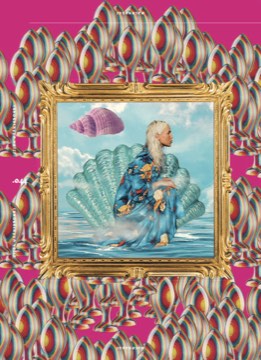
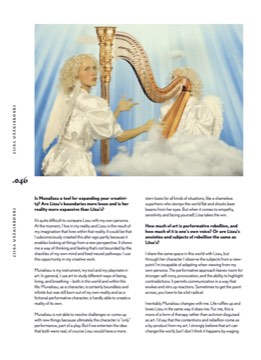
It seems that our universe expands only when parallel realities open. Yet such worlds only come to life through imagination. We then dive deep, try them out and report our findings to others. This is exactly what Liisa Vääriskoski has been doing with her superwoman character, Munalissu.
The artist seems to have been observing her surroundings, our surroundings, only to discover that the dominant culture is, in fact, insufficient. In an attempt to change structures, to build an extension, Vääriskoski has created Munalissu. A character so strong she now crushes cultural taboos while laughing at the boundaries of reality. A portal spirit, if you will, that operates as if conventionalism or the stranglehold that patriarchy has on people was a distant memory of a toxic cloud of gas in a far-away galaxy.
Is Munalissu a tool for expanding your creativity? Are Lissu’s boundaries more loose and is her reality more expansive than Liisa’s?
It’s quite difficult to compare Lissu with my own persona. At the moment, I live in my reality and Lissu is the result of my imagination that lives within that reality. It could be that I subconsciously created this alter ego partly because it enables looking at things from a new perspective. It shows me a way of thinking and feeling that’s not bounded by the shackles of my own mind and fixed neural pathways. I use this opportunity in my creative work.
Munalissu is my instrument, my tool and my playmate in art. In general, I use art to study different ways of being, living, and breathing – both in this world and within this life. Munalissu, as a character, is certainly boundless and infinite but was still born out of my own reality and as a fictional performative character, is hardly able to create a reality of its own.
Munalissu is not able to resolve challenges or come up with new things because ultimately the character is “only” performance, part of a play. But if we entertain the idea that both were real, of course Lissu would have a more stern basis for all kinds of situations, like a shameless superhero who stomps the world flat and shoots laser beams from her eyes. But when it comes to empathy, sensitivity and facing yourself, Liisa takes the win.
How much of art is performative rebellion, and how much of it is one’s own voice? Or are Lissu’s anxieties and subjects of rebellion the same as Liisa’s?
I share the same space in this world with Lissu, but through her character I observe the subjects from a viewpoint I’m incapable of adapting when viewing from my own persona. The performative approach leaves room for stronger self-irony, provocation, and the ability to highlight contradictions. It permits communication in a way that evokes and stirs up reactions. Sometimes to get the point across, you have to be a bit radical.
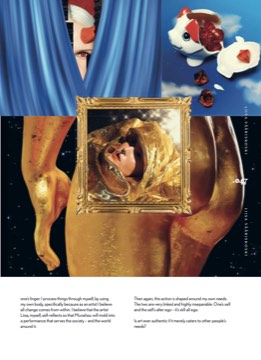
Inevitably Munalissu changes with me. Life ruffles up and loves Lissu in the same way it does me. For me, this is more of a form of therapy rather than activism disguised as art. I’d say that the contentions and rebellion come as a by-product from my art. I strongly believe that art can change the world, but I don’t think it happens by waging one’s finger. I process things through myself, by using my own body, specifically because as an artist I believe all change comes from within. I believe that the artist Liisa, myself, self-reflects so that Munalissu will mold into a performance that serves the society – and the world around it.
Then again, this action is shaped around my own needs. The two are very linked and highly inseparable. One’s self and the self’s alter ego – it’s still all ego.
Is art ever authentic if it merely caters to other people’s needs?
Next in Issue 001: My top 10 colors