Interview · Issue 001 · pp. 082–087 · 8 min read
Matti Vilho
- Interview / Juho Vesanen
- Photography / Juho Vesanen
- 3D art / Matti Vesanen
This story in print
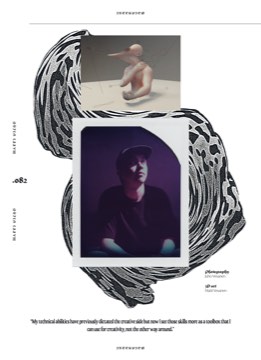
“My technical abilities have previously dictated the creative side but now I see those skills more as a toolbox that I can use for creativity, not the other way around.”
Matti Vesanen is a Visual Artist and entrepreneur who has always been extremely passionate about everything he chooses to pursue. At only sixteen he established Veli Creative, a video production company. After nearly ten years in advertising, Matti is now undertaking a Master’s degree in Directing Animation at the National Film and Television School (NFTS) in the UK. I would describe Matti as confident yet shy, shy but collaborative. Collaborative but self-reliant. But this is kind of hard since Matti is also my brother.
Was there ever a specific moment when you realized that you were going to be working with filmmaking and visual arts for a living?
There was no singular moment, but moving to Helsinki to study in a high school that specializes in visual arts was definitely a key moment. Not so much the school, but the people I met there. It was very significant in my life. Many of them are still some of my closest friends.
The students organized a lot of parties back then and I started doing the visuals. I got really interested in working with animation and particularly video as a medium. I’ve always thought that I can figure things out if I just keep going at it. So I started VJing by ripping video footage that I manipulated and remixed with my own 2D graphics. That led me to explore 3D which, at the time, was a whole new world for me. This exploration happened simultaneously with my VJing and eventually our company, Veli, started merging the two together. In our work, I started applying the techniques I had learned, doing visuals in some of our commercial jobs.
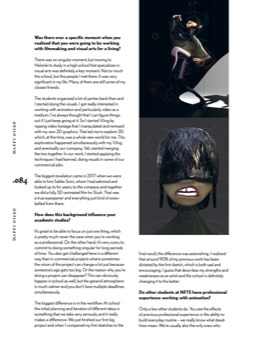
The biggest revelation came in 2017 when we were able to hire Sakke Soini, whom I had admired and looked up to for years, to the company and together we did a fully 3D-animated film for Slush. That was a true eyeopener and everything just kind of snowballed from there.
How does this background influence your academic studies?
It’s great to be able to focus on just one thing, which is pretty much never the case when you’re working as a professional. On the other hand, it’s very scary to commit to doing something singular for long periods of time. You also get challenged here in a different way than in commercial projects where sometimes the vision of the project can change a lot just because someone’s ego gets too big. Or the reason why you’re doing a project can disappear? This can obviously happen in school as well, but the general atmosphere is much calmer and you don’t have multiple deadlines simultaneously.
The biggest difference is in the workflow. At school the initial planning and iteration of different ideas is something that we take very seriously and it really makes a difference. We just finished our first big project and when I compared my first sketches to the final result, the difference was astonishing. I realized that around 90% of my previous work has been dictated by the first sketch, which is both sad and encouraging. I guess that describes my strengths and weaknesses as an artist and the school is definitely changing it to the better.
Do other students at NFTS have professional experience working with animation?
Only a few other students do. You see the effects of previous professional experience in the ability to build everyday routine – we really know what deadlines mean. We’re usually also the only ones who are able to reach deadlines on time (laughs). I mean, I get it. A school deadline is very different from a professional deadline. On the field, stakes are higher. Those of us with previous work experience also have a bit more consistent feel of what can be achieved in a given timeframe.
For me, a steady routine is very important. It allows me to really focus on what I’m doing when I’m doing it. However, the most creative moments can and usually will come at odd hours, but leaving space for them to appear is important and having a steady routine helps in that.
Do you think that you are in fact making up for lost youth taking up studying again? We did enter the professional world at a ripe age. Did we sacrifice our youth?
You might be onto something! But yeah, I don’t really feel that I’ve sacrificed anything. The route from A to B has been slightly unconventional but my working career has acted as my school and enabled me to pursue this MA with only a high school degree. It comes with a cost though since I have noticed that I do struggle with explaining my vision in more academic terms. I just don’t have the right words to explain what I do to others. I end up mumbling something about videos. Videos and stuff.
Are you undermining yourself now, knowing that you haven’t gone through the more conventional pipeline from school to internship to getting a job?
Look, I’m definitely very proud of myself and everything that we have achieved with Veli, but lacking academic achievements I sometimes find it hard to validate my successes. In the end though, I believe our experience as entrepreneurs has taught us to do everything by ourselves which helps in seeing the big picture in each project. Besides identifying as an artist now, I’ve noticed that I’ve found a bit of a producer in me as well. That’s fun.
What does creativity mean to you?
I think of it as a state of flow where everything feels easy and natural and you don’t have to wait for ideas to come up. You can’t really force creativity. A certain degree of idleness is required to be able to be creative, I believe. It’s just a shame we live in a world where you have to be busy to be considered successful.
Are there any specific moments or settings when creativity comes easy to you?
I walk and run quite a lot by myself, but oddly that is not when I get my ideas. More often it’s when I’m with my girlfriend and I just speak about random ideas out loud. That is when creativity seems to flow for me. It’s not even about the conversation but more about just being able to verbally express something that I’ve been thinking about in my head.
I’m good at creating visually strong ideas quickly, I can just sit down and start doing and trying – something decent will always come of it. But like I said, explaining myself and really crafting a solid story are things that I am still struggling with. So I try to improve, going to school is one step.
Is the reason why you’re studying to balance your strengths and weaknesses as an artist?
Absolutely. For me, it’s a lot about leaving my comfort zone so to speak. Trying to get better in committing to long-term projects and finding a new workflow in the process. My technical abilities have previously dictated the creative side but now I see those skills more as a toolbox that I can use for creativity, not the other way around.
Do you have an idea for your Master’s thesis yet?
I’ve been thinking of doing it somehow related to Nordic folklore. I’m really intrigued by the universality of storytelling and how everyone is a tale teller by nature. It’s something that we rarely acknowledge, but just telling someone how your day was requires a lot of ability to narrate. Even without formal education, we all recognize a good story. It’s the feeling we get.
That’s very interesting. Going back to your VJing, with ripping stuff and copying being a part of the culture, do you now feel the pressure to be original?
I really like the mentality in VJing and the culture where everything is allowed to a certain extent. It’s a great playground to explore different content and techniques without the pressure of stating “this is my art and it’s totally original”. It’s a different thing when it comes to installations for example. With installations you have to be original, whatever that means.
Is there a difference in directing live-action or animation?
I asked Wes Anderson the same question when he held a Masterclass at our school and he had a pretty clear answer. “There is no difference,” he said. After all, it’s about the story, the characters and emotion. I approach both mediums in the same way. There are of course some practical differences like not having to travel to locations but the process of producing, leading and managing a team of creatives is the same.
Do you identify yourself as an artist?
Yes I do, more and more now that I’m actively thinking about it and I have gained more experience. A lot of 3D-artists struggle with this though. Many identify themselves more as artisans and I can definitely relate to that. It’s so often about combining the brief with your own skill set and not that much about creating something from scratch.
You have a pretty wide range of experience working with different mediums from live-action commercials to art installations, working as a director, animator and editor. What medium or format interests you most at the moment?
Currently, stop motion animation is my main interest. Particularly the combination of live-action stop motion footage and 3D environments. There is something magical about seeing an actual physical object come to life! The experience is very different from creating, modelling and rigging a 3D-character digitally.
How do you see the future of creativity?
Coders are some of the most interesting artists at the moment and that trend will likely just grow in the near future. I’m very interested in generative animation, which means that you’d be working with an algorithm and teaching it to do the quick parts of creativity at a pace that us humans just can’t compete with. Artificial intelligence will be a big part of animation in the future. It already is, we just don’t really pay enough attention to it.
Inspiring, hey Matti what inspires you?
Silence and meditation. I’ve stopped listening to music that much. Often I’ll just sit and work with my headphones on but with no sound. There is something very intriguing about it. I also read a lot and lately I’ve been drawing inspiration from painting and photography.
Next in Issue 001: Day At The Beach