
Interview · Issue 002 · pp. 030–039 · 4 min read
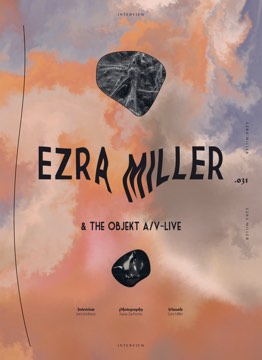
Ezra Miller & The Objekt A/V Live
- Interview / Joni Lindroos
- Photography / Kasia Zacharko
- Visuals / Ezra Miller
This story in print
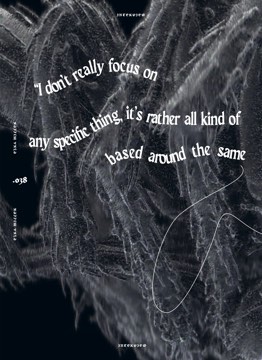
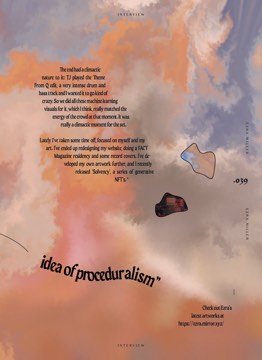
“I don’t really focus on any specific thing, it’s rather all kind of based around the same idea of proceduralism”
Ezra Miller is a Chicago-born wonderchild whose digital art is a textbook example of what it means to be multidisciplinary. Ezra balances between different media and techniques such as code and 3D resulting in otherworldly outcomes that are often something beyond understanding.
The artist’s recent clients include Balenciaga, Berlin Atonal, Nike and Alexander Wang. Before the pandemic hit, Miller collaborated with infamous DJ and producer Objekt to produce a mind-bending immersive A/V live-set.
Ezra, the stage is yours.
“I was born in Chicago and I grew up here. My dad is an artist, teacher and a film critic. My mom is also in the creative industry. Both my parents are artsy people. I think I just got into art through them.
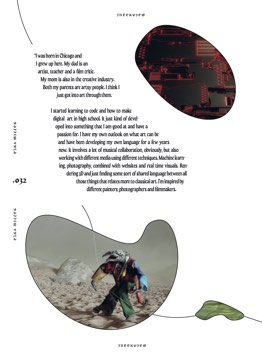
I started learning to code and how to make digital art in high school. It just kind of developed into something that I am good at and have a passion for. I have my own outlook on what art can be and have been developing my own language for a few years now. It involves a lot of musical collaboration, obviously, but also working with different media using different techniques. Machine learning, photography, combined with websites and real time visuals. Rendering 3D and just finding some sort of shared language between all those things that relates more to classical art. I’m inspired by different painters, photographers and filmmakers.
I’m kind of a generalist in that sense, where I don’t really focus on any specific thing, it’s rather all kind of based around the same idea of proceduralism. Being able to use different algorithms, procedures and tools with code to generate things that sort of let the computer be the artist. While in real time, what you are experiencing and seeing is happening live. That’s my approach.
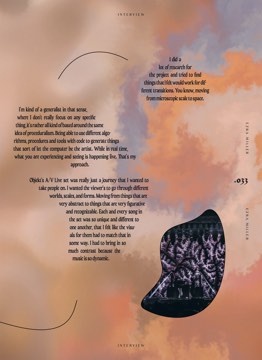
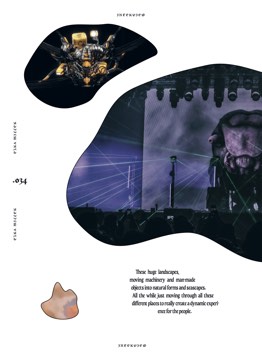
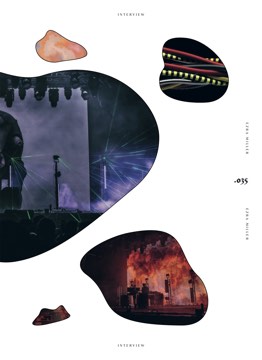
Objekt’s A/V Live set was really just a journey that I wanted to take people on. I wanted the viewer’s to go through different worlds, scales, and forms. Moving from things that are very abstract to things that are very figurative and recognizable. Each and every song in the set was so unique and different to one another, that I felt like the visuals for them had to match that in some way. I had to bring in so much contrast because the music is so dynamic.
I did a lot of research for the project and tried to find things that I felt would work for different transitions. You know, moving from microscopic scale to space.
These huge landscapes, moving machinery and man-made objects into natural forms and seascapes. All the while just moving through all these different places to really create a dynamic experience for the people.
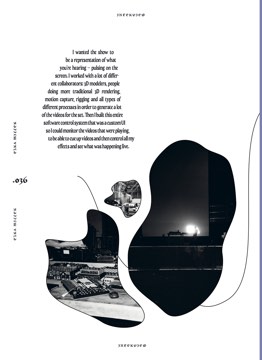
I wanted the show to be a representation of what you’re hearing – pulsing on the screen. I worked with a lot of different collaborators: 3D modelers, people doing more traditional 3D rendering, motion capture, rigging and all types of different processes in order to generate a lot of the videos for the set. Then I built this entire software control system that was a custom UI so I could monitor the videos that were playing, to be able to cue up videos and then control all my effects and see what was happening live.
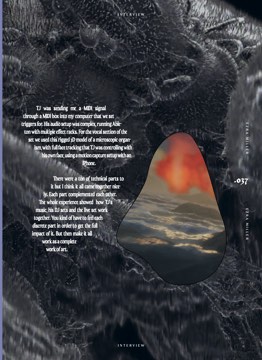
TJ was sending me a MIDI signal through a MIDI box into my computer that we set triggers for. His audio setup was complex, running Ableton with multiple effect racks. For the vocal section of the set we used this rigged 3D model of a microscopic organism, with full face tracking that TJ was controlling with his own face, using a motion capture setup with an iPhone.
There were a ton of technical parts to it but I think it all came together nicely. Each part complemented each other. The whole experience showed how TJ’s music, his DJ sets and the live set work together. You kind of have to feel each discrete part in order to get the full impact of it. But then make it all work as a complete work of art.
The end had a climactic nature to it: TJ played the Theme From Q edit, a very intense drum and bass track and I wanted it to go kind of crazy. So we did all these machine learning visuals for it, which I think, really matched the energy of the crowd at that moment. It was really a climactic moment for the set.
Lately I’ve taken some time off, focused on myself and my art. I’ve ended up redesigning my website, doing a FACT Magazine residency and some record covers. I’ve developed my own artwork further, and I recently released ‘Solvency’, a series of generative NFT’s.“
Check out Ezra’s latest artworks at https://ezra.mirror.xyz/
Next in Issue 002: Bad Director