
Essay · Issue 002 · pp. 046–053 · 6 min read
Fragments of thought on being a self-employed woman
- Writer & Photographer / Helen Korpak
This story in print
“Freelancing is like chipping away at Mount Everest with a little pickaxe.”
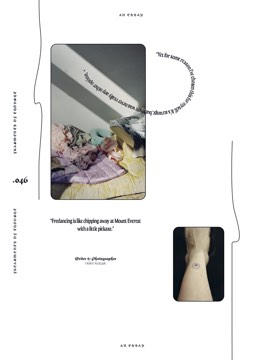
“Yet for some reason I’ve chosen this for myself. It’s strange, but there was never really any other option.”
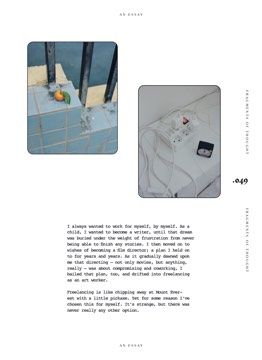
I always wanted to work for myself, by myself. As a child, I wanted to become a writer, until that dream was buried under the weight of frustration from never being able to finish any stories. I then moved on to wishes of becoming a film director; a plan I held on to for years and years. As it gradually dawned upon me that directing – not only movies, but anything, really – was about compromising and coworking, I bailed that plan, too, and drifted into freelancing as an art worker.
Freelancing is like chipping away at Mount Everest with a little pickaxe. Yet for some reason I’ve chosen this for myself. It’s strange, but there was never really any other option.
I. Postponing problems – in which I insure the health of the only employee of my company
The man on the other side of the desk in the claustrophobic glass box leaned towards me in a conspiratory manner. “I have to list any medical problems in the past five years as exceptions to the insurance you’re interested in buying from us”, he said. “But,” he continued slyly, “there’s a loophole you can use in the future. When five years have passed since your last meeting with a mental health professional, you can end your insurance – only to promptly draw up a new one. One identical to the previous one. Except for the fact that previous diagnoses won’t be included anymore.”
I nodded, regretting that I’d divulged being a patient of both a neurologist and a psychiatrist to this unknown man. I was doomed in any case, because the insurance company would eventually find out I was an epileptic recovering from clinical depression the moment they glanced at my medical journals.
Just a moment before, the sales agent had shown me his computer’s desktop wallpaper which depicted his dog – a stout West Highland White Terrier – frolicking on a neat lawn. He’d clearly wanted me to know that we were birds of a feather; two normal pet owners content with having a safe middle class life, because he followed up with a supposedly candid confession.
“I’m not one of those young hotshots that make ten thousand a month in commissions and drive a Mercedes. I live in Espoo, and I really, really get that it can feel almost cripplingly pricey to take out life insurance, but it’s a good idea for anybody self-employed”.
The new revelation that I was in fact a chronically ill art worker now suddenly obliterated the fake bond between us. I felt like a beggar.
Some twenty minutes later when I walked out of the office I had struck a deal and signed a contract. For an annual sum of roughly 400 euros I was to receive sick pay after 21 days of leave, if ordered by a doctor. No burnouts or other mental issues covered. No matter – I’d refrain from visiting a doctor until five years had elapsed and I could start all over again.
II. Dissecting bossladies – in which I reflect upon the very last thing I’d want to be known as
There is nothing implicitly beautiful or interesting in being a boss or being a woman, but for some reason many people seem to believe the opposite. They call female leaders working in the upper echelons of capitalism “bossladies” or “girlbosses”.
Both terms are amalgamations of the vapid female empowerment that runs rampant on the internet with the modern delusion that entrepreneurship is virtuous and meaningful. Using either is to betray all but an infinitesimal percentage of women globally, because the terms value the successful female above the humans on whose labour the bosslady builds her self-actualizing lifestyle.
For the bosslady nothing is enough. She sees herself as a fighter in a world of men; a noble warrior changing the way society works through personal profit. For the bosslady, money and power is synonymous with success, and so she keeps on repeating the same toxic patterns that have led us to the very specific multi-faceted inequality of the globalised world.
The bosslady believes the world would be a better place if more women were on the boards of the conglomerates that pollute and destroy our world. She doesn’t agree with Michel de Montaigne when he states that “the profit of one man is the damage of another”. The self-congratulatory way in which she defines herself makes her blind to the fact that millions and millions of women are bosses and entrepreneurs – just not in the same way she is.
III. Life under the influence of love – in which I confront the fact that emotional labour diminishes my work capacity
In Ingeborg Bachmann’s 1971 novel Malina, an unnamed narrator lets her life revolve around men. She lives in Vienna’s third district with the titular character but is also obsessed with the emotionally distant Ivan, who lives on the same street and who lets her enter his life to a limited extent. The narrator is a famous writer but Ivan is disgusted by misery in literature and wants her to write something with a happy ending, which she attempts while increasingly dodging phone calls, telegrams and letters due to anxiety and preoccupation with her infatuation. She self-sabotages an in-depth interview with the star reporter of a big newspaper and the replies she writes to letters received are torn up and left unsent.
Ivan’s coldness is something the narrator constantly has to adjust to and process, and as she descends into a vortex of overthinking, it quickly becomes clear that her mental health has deteriorated to a point where working is impossible. As she puts in a letter:
“Dear Herr Schöntal, for years now I have been unable – this often lasts for weeks – to answer the door or pick up the telephone or call someone, it’s impossible for me, and I don’t know how I might be helped, I am probably beyond help already. [...] I’m also completely incapable of thinking about things people tell me to think about, about deadlines, work, appointments [...]”.
Bachmann weaves together a novel in which the narrator’s addiction to taking on a female role completely cripples her professionally. With self-employment comes a requirement of self-discipline and independence. Being one’s own boss is not the same as to be free.
Most people – and perhaps women in particular – who pursue self-employment as art workers are working under the harshest leadership imaginable. To express oneself whilst also searching for meaning through romantic love is more than a burden, it is a Sisyphean task.
Malina is fiction, but its status as a modern classic partly stems from its intensely painful relatability. Assuming a feminine role is so deeply rooted in most cisgender women that it is repeated over and over again, even despite struggles to refrain from doing so. Malina’s narrator who wastes her life anguishly longing for love is anything but pathetic – she is me, she is many of the women I know.
The author Bachmann pens clearly sees her own situation from the outside: “For the longest time I had no feelings at all, since those years I was entering the age of reason. Nonetheless, like all women I naturally always had men on my mind, for the above mentioned reasons, and I’m sure in turn, the men gave very little thought to me, only after work or maybe on a day off.”
As I navigate through life, my workload is often double the visible amount: there are the concrete things I do for money, such as write and photograph, and then there is the emotional labour that goes into being able to do these things.
“Malina pretends to be horrified but has to laugh: You’re not claiming that women are more unhappy than men, are you!”
Of course not, I’m only saying that women face unhappiness which is particularly inevitable and absolutely unnecessary.”
It’s a perpetual process, to live through this all.
Lately I’ve constantly been thinking about finding work and above all, about having a monthly income. I think about applying for a job on a daily basis, but when it comes down to it, I’m too scared. There must be something deeply important that tethers me to this lifestyle. I just don’t know what it is. Yet.
Next in Issue 002: On happiness with Anton Tammi