
Essay · Issue 002 · pp. 094–099 · 12 min read
Ghost ship in the machine: On the Emergence and Responsibility of the Cybernetic Film Director
- Writer / Matthew C. WIlson
- Illustrations / Artificial intelligence
This story in print
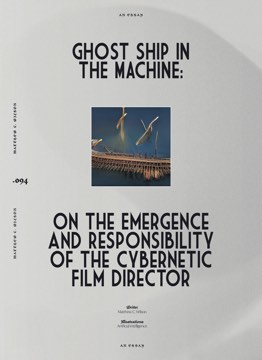


When the ancient Greeks completed a ship’s construction, they named it and applied decoration – sometimes elaborate – including sets of eyes. Their ships became an animate apparatus composed of human bodies, wood, seafaring knowledge, and a system of communication between the ship’s crew. Similarly, films are made by vast collaborative teams of people – the “crew” – with creative, technical, and managerial expertise, accompanied by copious equipment including the omnipresent, invisible, and unnamed character of the camera itself. Situated within this complex apparatus, the director is typically regarded as the head of the film crew.
The word “director” came to English through a Medieval mish-mash of phoneme shuffling on the European continent, spilling across the channel to Britannia. Syllables were as fluid as borders following the disintegration of the western half of the Roman Empire. For the Latin-speaking Romans, a director was a “governor” since dirigere meant “to guide” and the role of the governor was to guide the body politic – a metaphor borrowed from the sea-faring Greeks. The etymological origin of Latin gubernator, “governor” is kubernáō (κῠβερνᾰ́ω), “to steer.” The kubernḗtēs (κῠβερνήτης) is the steersman who guides the ship.
Governors also appear in brains, as the “central governor,”¹ and certain machines, as the “centrifugal governor.”² The steersman, the kubernḗtēs, charts another etymological course to the present: cybernetics, coined in 1948 by Norbert Wiener and designated as “the entire field of control and communication theory, whether in the machine or in the animal.”³ Adjacent to the paradigm of behaviorism in psychology, and amidst the dawn of programmable computing, it was quite logical to study organisms and machines under the same theoretical framework.
Cybernetics is the matrix from which artificial intelligence emerged in the next decade.⁴ While cybernetics focused on the feedback within organisms and machines as well as between humans and machines, artificial intelligence took up the task of creating intelligent, or seemingly intelligent, systems. The self-driving car has become one of the proof-of-concept projects for the artificial intelligence community. Meanwhile, increasingly autonomous military drones are the shadow of commercial AI innovations/applications. The camera too is losing its “steersman.” While a camera once needed a photographer to guide an image into existence through dialing in appropriate settings and focus, it can all happen now with the tap of a smartphone’s virtual shutter release button. With the advent of computational photography, machine learning is transforming the photographic and cinematographic apparatus through algorithms, simulating effects like depth of field during image post-processing and achieving greater dynamic range through automatically compositing images with different exposures. These and other advances will increasingly appear on dedicated cameras, and eventually be included in cinema cameras, bringing an array of new “programmed freedoms”⁵ to commercial film production.
Parallel to the transformation of the digital camera, large portions of many contemporary films are already produced without any photons exciting an electronic emulsion. The fidelity with reality as rendered by light in space which contemporary CGI has achieved, offers a glimpse of a future in which a camera is not necessary at all. Given the extremely time consuming process of manually producing computer generated imagery, much of the modeling is increasingly produced procedurally by combining human-produced elements with generative algorithms. Additionally, machine learning image systems can already replace one face with another – the deep fakes. The technologies to produce synthetic audio are also in place. In the future, to star in a film, actors may only need to license their likeness. Machine learning can also produce photograph-like images from lines and color coded shapes, an algorithmic trompe l’oeil that can produce spatial effects across time. Other systems can even translate text into scenes. It is not difficult to trace these trends forward and imagine a mode of filmmaking which does not require filming anything at all.
Like cinematographers, screenwriters and editors will imminently become cybernetic, working in a feedback loop with narrow AIs that optimize and extend the capabilities of their work. It has been five years since filmmaker Oscar Sharp and AI researcher Ross Goodwin conceived of Sunspring, a film released online whose script was written by an AI named Benjamin, trained on ‘80s and 90’s sci-fi screenplays.⁶ Five years have also passed since IBM’s Watson edited a film’s trailer.⁷ A screenwriting AI assistant can propose endless possibilities to overcome writer’s block while an editing AI can propose infinite edit options for a film editor to review and select. Needless to say selecting from options takes much less time (and costs much less) than generating those options. It may not be long before we see an AI used for managerial tasks like efficiently managing resources and producing optimized shot lists.
Within the filmic apparatus, machine learning is also impacting roles at the highest level of decision making. In the era of big-data, producers and studio executives can use machine learning systems to analyze historical data and decide everything from which films are made to how a film should end, Including pre-selecting films for production consideration and proposing cast, biased of course toward films that will do well at the box-office.⁸ Such cybernetic integration of narrow AIs throughout the process will enable financial optimization at a scope and level of detail previously impossible.
For now, the director, the one who steers the film and guides the crew, is safe from replacement. The narrow AIs available are still far from the general intelligence a film director needs to function in and synthesize many different domains. But a decade or some decades out, the film director will also become a director of machine intelligences – interfacing, joining in cybernetic union.
These developments within the cinematic apparatus begs a Ship of Theseus type of question: if many of the traditional processes of filmmaking are replaced by a human working with an AI component – a cybernetic (sub)system – is it still a film? Or is it now something else, something other? Since cinema’s early days it has explored alternate realities and possible futures; now the same Hollywood studios that manufactures films about AI takeovers may not be safe from the that something else emerging in their studios. How long will it be before the artificial intelligence already operating within the apparatus can entirely synthesize a film without the need of any actors or any cameras? And what kind of films will cybernetic directors – who must answer to producers – generate for their human audiences?
Cinema helped to form the behaviors of the modern subject – showing what is normal, what is rewarded or punished, and what is desirable. Films, as ideological vehicles, are integral to cultural programming. What will be the ideological inclinations of the cybernetic director? Cinema, and art generally, perform the ultimate expression of individuality, associated with freedom, and self-actualization, a lingering set of connotations inherited from the history of modernism and more recently promoted by the cultural battle against communism during the Cold War. The ships of the ancient Greek served as vessels of both commerce and war; the same could be said for films. Cybernetics was deeply entangled with the military, as well (both in the US and the USSR). Will the dominance of the contemporary military-digital complex follow the military-industrial complex, as a significant influence in the development of AI? And then, in turn, to what degree – and degree of visibility – will cultural production utilizing AI be conditioned by the same logics? Should we be concerned, then, about the emergence of a new cybernetic auteur director? Or the disappearance altogether of a human in the loop, with films conceived of and generated entirely by artificial intelligence but circulated for human audiences?
If the present is any indication: yes. It has been shown repeatedly that the coding and training of AIs embeds social biases – inherited from the culture that produces them. This has frequently meant predominantly white, male programmers and biased training sets.⁹ Challenging this and taking an ethical stance in the AI industry is not always welcome.¹⁰
This is of course also reminiscent of the white, male dominated cinema system of Hollywood. Challenging these norms, once done primarily in the domain of independent filmmaking, has made some progress into the dominant industry, though still the #OscarsSoWhite and also so male, so heteronormative, and so CIS gendered.
Already 50 years ago, Jean-Luc Godard famously said that “The problem is not to make political films, but to make films politically.”¹² That is to say, a film is political not simply in its message or stylistic choices; it is political most of all in its mode of production. With the stages of filmic production ever more mediated, attention to production becomes ever more necessary. When an AI becomes involved, it is crucial that at every stage – from coding to training, from greenlighting production to awarding of accolades – of the emergence of the cybernetic director, and perhaps some day the AI director, the values, norms, and practices of production are critically examined. It becomes the responsibility of the cybernetic director to ensure this realm is not a reproduction of the current one in which dominant groups subordinate others to their cultural logic and/or exploit others for economic benefit.¹³
Social values are encoded at every scale of a system. Those values are woven into world-views. In the religiophilosophical battle of free will versus predetermination, the notion of free will won. Humans are self-directing, each expressing our own individual will. At least that’s the story told in the bubble of Western (neo-)liberal democracy. Neo-liberal subjects are the ideal directors, film directors and other directorial roles, as they are socialized to believe they are in control and enter into competition with others in the market. Yet there remains the steering of the individual by an invisible agent, a distributed agent which is everywhere within the culture, the ideology of the society. The subject is left to run through decision-trees provided by education and culture; in turn the cultural producers most often reproduce these ideologies, closing the feedback loop. The director, the steersman, the kubernḗtēs, the governor simply steers; the orders come from the captain of the ship. Like the camera operator, the neo-liberal subject has only programmed freedoms, analogous perhaps to a passenger in a driverless vehicle. This is not the kind of empty vessel the masters of the Tao had in mind:
If someone is crossing a river
And an empty boat collides with their own skiff,
Even though they may be bad-tempered
they will not become very angry.
But if they see someone else in the boat,
They will shout at them to steer clear.
If the shout is not heard, they will shout again,
And yet again, and begin cursing.
And all because there is somebody in the boat.
Yet if the boat were empty.
They would not be shouting, and not angry.
If you can empty your own boat
Crossing the river of the world,
No one will oppose you,
No one will seek to harm you.¹⁴
Ghost ship. Ghost in the machine. Ghosts of history. In a near future, the director approaches an apparition mirrored in algorithms. What will they see? The values programmed into the system and selected for its training data will determine that. Human filmmakers – without the aid of an AI collaborator – have long since cast women as heroic leads and even the Hollywood system has opened to cinematic worlds beyond the world of white narratives; on the one hand this is progress, but on the other, too often, the same films maintain such underlying logics as patriarchy and capitalism.¹⁵ Independent films and artist films not subject to industrial production and the expectations of the audiences of mass culture can (and should) push farther.
“The real emancipatory potential of technology remains unrealized.”¹⁶ As a start at the most basic level of the source code, can programmers of systems used to produce synthetic images rethink the “adversarial” nature of generative adversarial networks to function based on systems of co-operation? We must liberate algorithmic cinema, algorithmic governance, and the algorithmic future from the hierarchies of history still active in the present. Only once that horizon of understanding has been radically altered may an AI begin to image worlds beyond our immediate grasp, and from which we might yet learn how to forge other worlds ourselves.
Acknowledgements: Thanks Christopher Williams-Wynn and Ben Hoffman.
Footnotes
¹ The central governor prevents an over-exertion of physical activity that might threaten homeostasis.
² Centrifugal governors maintain a form of homeostasis in steam engines, through regulating fuel and other fluid flows through a feedback mechanism. As a general machine the steam engine can be seen as part of the modern computer’s genealogy.
³ Cybernetics, or, Control and Communication in the Animal and the Machine by Norbert Wiener
⁴ John McCarthy coined the phrase “artificial intelligence” in order to distinguish it from cybernetics at a workshop at Dartmouth College in 1955. Cybernetics became mixed up with psychedelics and largely dropped out of the mainstream. Meanwhile, artificial intelligence set up shop at MIT as the “AI Group” under the direction of John McCarthy and Marvin Minsky. Minksy advised film director Stanley Kubrick in the development of 2001: A Space Odyssey’s HAL9000.
⁵ See Vilém Flusser’s Towards a Philosophy of Photography for further discussion on the photographer’s relation to the apparatus of the camera.
⁶ See “Movie written by algorithm turns out to be hilarious and intense” by Annalee Newitz https://arstechnica.com/gaming/2016/06/an-ai-wrote-this-movie-and-its-strangely-moving/
⁷ “IBM Research Takes Watson to Hollywood with the First “Cognitive Movie Trailer” by John R. Smith https://www.ibm.com/blogs/think/2016/08/cognitive-movie-trailer/
⁸ “Hollywood is quietly using ai to help decide which movies to make: AI will tell you who to cast and predict how much money you’ll make.” by James Vincent for The Verge. https://www.theverge.com/2019/5/28/18637135/hollywood-ai-film-decision-script-analysis-data-machine-learning
⁹ See https://nooscope.ai/ for extensive discussion of machine learning errors, biases and limitations; prepared by Vladan Joler and Matteo Pasquinelli, 2020
¹⁰ As has been most visible with Google’s firing of Timnit Gebru, founder and co-head of Google’s AI ethics unit.
¹¹ StyleGAN was developed by NVIDIA, version 2 was released as open source code in February 2020. A StyleGAN2 model was trained on drawings and etchings of Greek ships/triremes. GANs are generative adversarial networks, a subclass of machine learning algorithms that use neural networks. Machine learning is a component of artificial intelligence, but is not equivalent; it is one of the forms of narrow AI, an AI that primarily does one thing. There are no known general AIs at this time.
¹² Godard, cited in Colin McCabe, Godard; Images, Sounds, Politics (Bloomington, Indiana University Press,1980), p. 19.
¹³ This point is elaborated in greater detail in, for example, the introduction of Atlas of Anomalous AI, edited by Ben Vickers and K Allado-McDowell.
¹⁴ Chuang Tzu “The Empty Boat,” edited version of Thomas Merton’s translation
¹⁵ For example, Black Panther (2018) showed Hollywood a film directed by a black director, featuring a predominantly black cast can bring huge earnings. Nonetheless, as Jonathan Ward observes, “The world of Wakanda, as imagined in Black Panther, is one where patriarchal monarchy, male privilege, heteronormativity, and capitalism still remain central and uninterrogated. The only possibility that is offered by the film in terms of undoing the legacy of colonialism is that of access to resources/technology.” Jonathan Ward, “Wakanda liberation is this? Interrogating Black Panther’s relationship with colonialism,” Slavery & Abolition (2020), 41:1, 14-28 (24).
¹⁶ Quoted from “Xenofeminism: A Politics for Alienation,” by Laboria Cuboniks, which elaborates on this (unrealized) potential https://laboriacuboniks.net/manifesto/xenofeminism-a-politics-for-alienation/
Next in Issue 002: Ima Iduozee