Interview · Issue 002 · pp. 072–077 · 7 min read
On living free with Auden Bui
- Interview / Priya Lorenz
- Photography / Auden Bui
This story in print
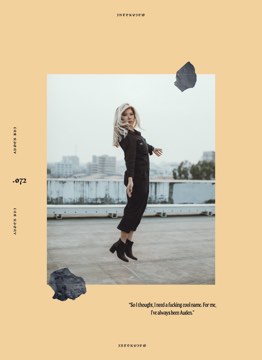
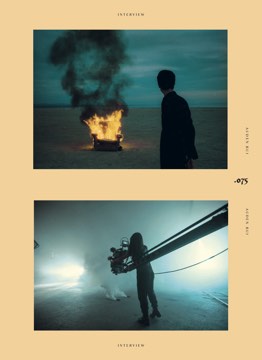
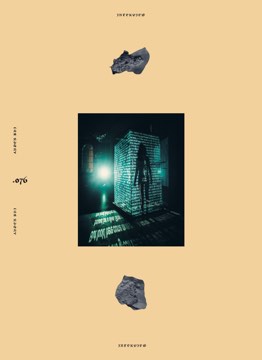
“So I thought, I need a fucking cool name. For me, I’ve always been Auden.”
Auden Bui is a Directors Guild of America Award winning director and a lovely human being. Born in Vietnam and having immigrated to the U.S. at the age of six, Auden received a BA from University of California, Berkeley. While studying at Berkeley, Auden won the Will Eisner Comic Industry Award, for photo-imaging before moving onto pursuing her MFA at USC School of Cinematic Arts. Auden has been accepted into the prestigious Warner Bros. Television Directors’ Workshop and is currently writing her 4th feature-length screenplay.
The filmmaker and amateur collector of rare and unusual things also holds a lordship title from the micronation of Sealand which is pretty awesome.
In this global fever dream Auden is a unique creator. She is somewhat of a lone wolf roaming the downtown Los Angeles studio loft surrounded by relics of the past. And hats—lots and lots of hats. Auden is content being on her own and is one of those rare types who seem to tap into the silence that most people tend to avoid, for inspiration.
During a time of to do lists, countless activities and adult playdates on Zoom, Auden sits at a desk in the epically furnished studio and marinates in stillness. Although noticeably self-contained, she is not immune to the city turmoil that surrounds her from the streets below. To escape the beautiful yet mind-numbing chaos that is the City of Angels, Auden tends to flee to a forested cabin in a forgotten corner of the U.S., the state of Maine. A complete departure from her usual lifestyle, one could imagine.
Although temporarily unable to travel abroad, Auden is known to satiate her wanderlust by journeying to Antarctica in search of glaciers, Papua New Guinea for other magnificent types of forms or to spend time with indigenous locals in the mountains. She truly is a woman of the world.
Traveling for Auden, is the most formative factor influencing her creative work. That and movies. Growing up, she felt trapped in a restrictive household and instead turned to movies for a welcome escape. Films started slowly occupying the majority of her time and eventually young Auden went as far as completing her school assignments during lunch time just so she could rush home and watch whatever movie was playing on TV.
Watching all the stories unravel before her, Auden found herself yearning for something that she couldn’t quite put her finger on. An unquenchable thirst for something she couldn’t quite identify. Not until on the cusp of adulthood when that thing started to unravel. A thing she needed, something constantly on the tip of her tongue yet escaping her consciousness – freedom.
For Auden, this was not the kind of freedom that makes you shave your head and join a nudist commune, nor the kind where you shout your secrets from the rooftops. Feeling free was something deeper than that. A sense of liberation not found in books or movies. Nor was it to be found in other people. Freedom, Auden believed, could only be found in the act of exploring. And so, turning eighteen, Auden packed her bags and left everything she knew to travel to places she had only seen in movies.
Nowadays, Auden primarily journeys to places with vibrant wildlife and untouched nature. “Nature is a huge part of my life. I prefer it to the city. The more time I spend in nature, the more pessimistic I become about people,” she confirms. And continues, “I feel distant from people and more in tune with the Earth. I suppose this is why, in my films, I also portray humans as very flawed creatures.”
In her DGA student award-winning sci-fi film, The Lost City of Tomorrow, the notion of humans as innately flawed and vulnerable creatures can be felt from start to finish. Auden paints her characters as both troubled and deeply flawed yet she infuses their dramatic arcs with a sense of growth and optimism. Her work treads the line between dark and ironically playful with grace and ease.
When I ask what inspires her to write screenplays (she has completed three within the last year), the filmmaker becomes thoughtful. With eyes shifting to a window off-screen, she ponders the question. “It changes all the time but right now, I’m really interested in the work of Alexander Von Humboldt.”
For those not familiar with Humboldt, he was a German naturalist in the 1800’s who heavily influenced the likes of Charles Darwin and Ralph Waldo Emerson. Some refer to him as “The Father of Nature’’ due to the philosopher’s closeness to the natural world and his passion for preserving its beauty. In the era of leaders and luminaries focusing on outward expansion and conquering new lands, Humboldt had his eyes set on the future and the long-term impact of humankind on this planet. Humboldt understood that humans were a threat to nature and he made it his life’s mission to spread this awareness through his writing.
Speaking of Humboldt, Auden looks dreamy as if talking of long-lost love. “I’ve been really inspired by him,” she continues, “People mostly forgot about him since he wasn’t as flashy as Darwin. World War II also caused Germans to fall out of fashion in the U.S. so his work wasn’t promoted as it should have been.”
But why would one feel so drawn to a stranger who lived over a century ago? And how does that influence the process of filmmaking? “It’s his understanding of life and humanity. Humboldt is able to connect everything because he was a poet and very much in touch with his emotions. He didn’t think science and emotion had to be separate. Everything in humanity is intertwined. This has inspired me to incorporate different elements in my own work.”
Auden is on an ongoing mission to collect the philosopher’s entire anthology of books, of which she currently owns two. A longer process since the works are both expensive and rare. It seems that this is a pattern in Auden’s life and her film work. The filmmaker seeks out that which is rare, untouched and hard-to-attain.
That is also the reason why she chooses to travel to faraway places and why she enjoys waking up at 5AM to attend obscure estate sales where she finds treasures pregnant with stories untold. Upon watching her film work, it becomes abundantly clear how her perspective on living weaves its way into the stories she tells on screen.
A constant theme that acts as a pulsating artery throughout her work is a thirst for adventure – and the freedom it brings. “Traveling is the ultimate adventure. Seeing how people live in remote parts of the world, that underlying freedom they have. It made me realize that I didn’t need all the things I thought I did. There is always a part of me that is willing to take a major risk because I know that I can lose it all and be fine with it.”
Auden’s way of living and the films she makes really forces one to think. “My dream is to stay true to myself and create work that I’m proud of until I die. I just don’t want to sell out.”
But what then is selling out?
“Making films that are not true to me, films that other people want. Lots of filmmakers rely too much on the message and forget about the art of visual storytelling. I don’t want to make films just because I know they will do well in festivals. The transgender woman with cancer facing adversity in an impoverished town-type of thing. I want to tell different types of stories. Part of what drives my creative work is seeking new and ever-evolving experiences. Through these experiences, I can tell stronger stories in a more unique way.”
Laughing, Auden exhibits an endearing self-awareness. Serious things are being said, yet without the burden of becoming too serious. What about the future, I ask. “One day, I’d like to live in a lighthouse. That would be so cool.” There is nothing more remote or beautifully alone than a lighthouse out at sea.
“I think it’s important to not wait to do what you want to do. Like with my name.” Auden adds, “I actually named myself. I changed my name when I was fifteen. And not because of the poet. It was part of an essential realization that I wanted to do something great with my life and in order to do something great, I needed a great name. So I thought, I need a fucking cool name. It took me a year to finally come up with Auden. I never connected with my given name. For me, I’ve always been Auden.”
Next in Issue 002: Materialism vs. Materialism