
Feature · Issue 003 · pp. 082–089 · 3 min read
Caracara Collective
- Words & photography / Joni Stanley
- Visuals / Antoine Paikert
This story in print
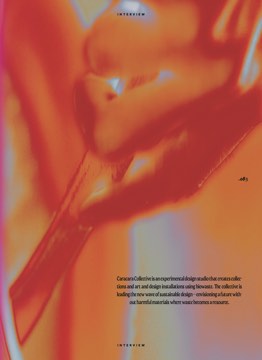
Caracara Collective is an experimental design studio that creates collections and art and design installations using biowaste. The collective is leading the new wave of sustainable design – envisioning a future without harmful materials where waste becomes a resource.
In nature there’s not really such a thing as waste, everything eventually goes back to use.
“In nature there’s not really such a thing as waste, everything eventually goes back to use. We try and base the whole life cycle of our work on that same principle of circularity.”
“Caracara’s material research aims to create 100% organic, biodegradable and durable materials that can be implemented wider in design, art and architecture. We aim to show that useful resources exist almost everywhere by researching, experimenting and showcasing what can be done with, for example, discarded parts of crops. We wish to inspire others to create change in their local communities through working with existing waste streams.”
“We are always expanding our material library depending on who we meet and where we go. Our main raw materials are orange peel and pine needles from discarded Christmas trees. Lately we have also started working with sea buckthorn skins, scobies and garden waste”.
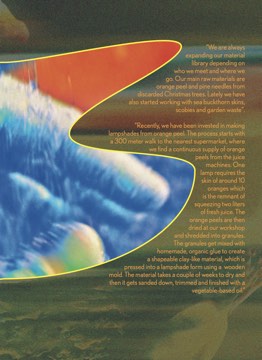
“Recently, we have been invested in making lampshades from orange peel. The process starts with a 300 meter walk to the nearest supermarket, where we find a continuous supply of orange peels from the juice machines. One lamp requires the skin of around 10 oranges which is the remnant of squeezing two liters of fresh juice. The orange peels are then dried at our workshop and shredded into granules. The granules get mixed with homemade, organic glue to create a shapeable clay-like material, which is pressed into a lampshade form using a wooden mold. The material takes a couple of weeks to dry and then it gets sanded down, trimmed and finished with a vegetable-based oil.”
The future is fungi
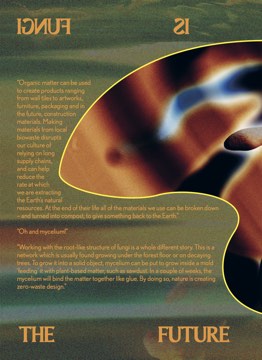
“Organic matter can be used to create products ranging from wall tiles to artworks, furniture, packaging and in the future, construction materials. Making materials from local biowaste disrupts our culture of relying on long supply chains, and can help reduce the rate at which we are extracting the Earth’s natural resources. At the end of their life all of the materials we use can be broken down – and turned into compost, to give something back to the Earth.”
“Oh and mycelium!”
“Working with the root-like structure of fungi is a whole different story. This is a network which is usually found growing under the forest floor or on decaying trees. To grow it into a solid object, mycelium can be put to grow inside a mold ‘feeding’ it with plant-based matter, such as sawdust. In a couple of weeks, the mycelium will bind the matter together like glue. By doing so, nature is creating zero-waste design.”
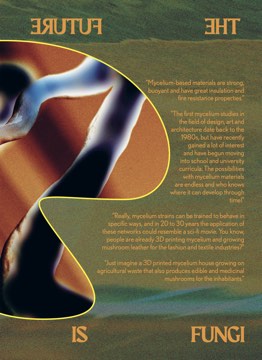
“Mycelium-based materials are strong, buoyant and have great insulation and fire resistance properties.”
“The first mycelium studies in the field of design, art and architecture date back to the 1980s, but have recently gained a lot of interest and have begun moving into school and university curricula. The possibilities with mycelium materials are endless and who knows where it can develop through time!”
“Really, mycelium strains can be trained to behave in specific ways, and in 20 to 30 years the application of these networks could resemble a sci-fi movie. You know, people are already 3D printing mycelium and growing mushroom leather for the fashion and textile industries?”
“Just imagine a 3D printed mycelium house growing on agricultural waste that also produces edible and medicinal mushrooms for the inhabitants.”
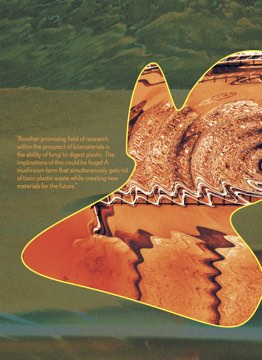
“Another promising field of research within the prospect of biomaterials is the ability of fungi to digest plastic. The implications of this could be huge! A mushroom farm that simultaneously gets rid of toxic plastic waste while creating new materials for the future.”
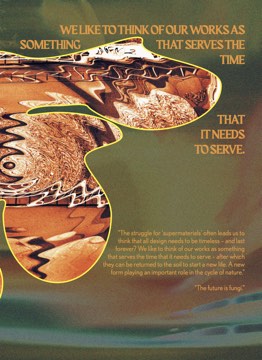
“The struggle for ‘supermaterials’ often leads us to think that all design needs to be timeless – and last forever? We like to think of our works as something that serves the time that it needs to serve – after which they can be returned to the soil to start a new life. A new form playing an important role in the cycle of nature.”
“The future is fungi.”
We like to think of our works as something that serves the time that it needs to serve.
Next in Issue 003: Ilkka Halso