Interview with Hannele Rantala · Issue 003 · pp. 036–043 · 5 min read
Hannele says
- Words / Helen Korpak
- Photography / Hannele Rantala
This story in print
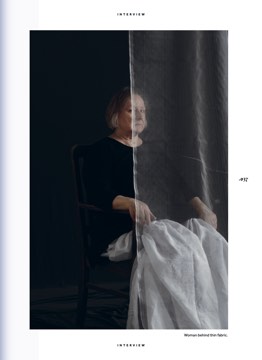
“Hannele says she writes fiction, but that all of it is true.”
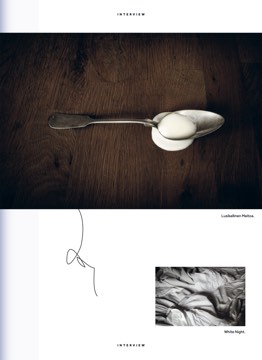
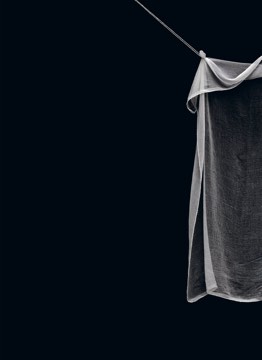
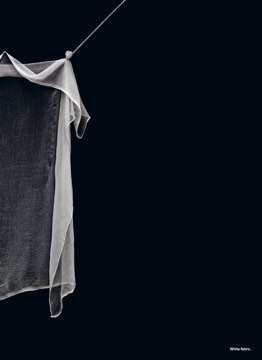
Hannele tells me she starts writing her texts from the middle. Like a sculptor working on a block of marble, only the other way around: from the center towards the surface rather than from the outside, inwards. Like herself when creating photographs of inanimate objects set against a black backdrop: first the item, then the light that brings forth shapes and textures, that creates three-dimensionality. The center can hold.
Writing and rewriting, editing and re-editing. Draft after draft, cutting away sentences, adding words, changing the order. Little by little, it all begins to crystallize and the text reaches its final form. In Hannele’s case, that means it has come to a point at which only the essential remains, precise and devoid of nostalgia, often devastating and yet never lachrymose.
Hannele says she writes fiction, but that all of it is true. It comes down to this: writing is choosing. Choosing a point of view, choosing a vocabulary, choosing words. Choosing focus. Humans create narratives in order to make sense and to cope. The memories that will fade away are those that do not relate to the creation of our self.
It feels impossible to take on the role of a passive listener when meeting Hannele – she is so absolutely present, and the things she talks about seem to open a small door within my brain. An avalanche of thoughts and insights rush through the tiny opening, and suddenly there’s so much to discuss, so much to tell and to share. I tell her about how childhood memories of shame are those that remain after all this time. She knows what I mean. Shame forms us, our childhood forms us.
Every time Hannele gets asked to provide a biography, she creates a new one. At this point, around two hundred different ones exist. The reason is simple: the image and the word are incredibly imperfect ways in which to express oneself. A biography is just a version of events, and a narrow one at that. Hence: true, but also fiction. We’re fictive beings to ourselves, too.
One of Hannele’s latest biographies was written for the exhibition Dialogue, shown at Ateneum Art Museum in early 2022 and co-created with Elina Brotherus. It’s stunning work. The purpose of her constant rewriting and re-editing becomes clear: what she presents the reader is a chronology in which only the essential is included. What creates an artist? Not the things listed in their CV, but the things they carry with them through life. Those earth-shattering experiences and hardships that are an unavoidable part of human life. Our early relationships. All the fleeting moments that change things forever. Hannele lists them all. The moment she truly learned what hate is. The time she was almost raped. The period of poverty. Each of them with a year attached. These are the things that have led to Hannele becoming who she is, and to Hannele’s art being what it is.
When writing or creating art over a long period of time, and doing so with honesty and with an open heart, the same themes will keep floating to the surface, time after time again. I try to write about a wide variety of subject matter, but to my chagrin I keep returning to the same themes – themes that are deeply rooted in my personal life. As Hannele talks about experiencing the same, I come to think of Louise Bourgeois processing her relationships with both of her parents for more than half a century. The past follows us. It is inescapable.
The central part of Hannele’s biography, the key to everything, comes early on. War enters her life in childhood – not as a current event (she is born seven years after the end of WWII), but as an echo reverberating through her mother for whom war changed everything. War is present in their relationship, it dictates her entire upbringing. “I’ve been brought up to survive”, Hannele says. “Everything boils down to my mother bringing me up to survive when the war comes”.
The second line of Hannele’s Ateneum-biography reads: 1956 - Mother teaches me to survive train journeys alone. I have a mustard-yellow matching jacket and hat and red gloves.
Hannele says: “This is the moment in which I change. All of my works build upon this event. There’s nothing I can do about it. Every single one of my works can be viewed through this lens. That small girl traveling alone by train at age four. It’s not a choice.”
This is evident in many of Hannele’s works. Before Important Things, 2021, is one of them, as well as one of Hannele’s many series in which she combines photographs and words. The result is not a collection of images illustrating her texts, nor is it a compilation of pictures supported by captions. The written word is one voice, the photographs make up another. They intertwine, integrate into one another, yet remain separate.
Before Necessities sees Hannele depicted sweeping Helsinki’s Albertinkatu. The street runs from Kamppi southwards all the way down to the playground that constitutes the final frontier before Punavuori turns into fancy Eira. Daylight illuminating the gray street, Hannele broom in hand over the course of sixteen photographs under which sixteen texts are printed. They seem to consist of memories: true ones, but in fictional form because nothing else is possible when attempting to put an event into words – it is always merely a sliver of an impression of reality.
“There’s nothing I can do about it”, Hannele says. War intercepts her memories, it lurks under the surface, it bursts through, it is present in a myriad of different ways. Hannele’s biography contains other wars than just the one that took place before her birth. She has lived in the Soviet Union in the 1980’s, she has learned what totalitarianism looks like, what fear looks like. She has learned what hate looks like, and can trace the exact moment of that happening. Throughout her entire life, she has encountered the dark sides of humanity and learned how they operate. She knows the root of the war currently shaking Europe to its core.
And yet – or is it because of all of this? – Hannele believes in freedom, in the individual being able to choose whether one’s hand is used to caress or to strike. She looks me straight in the eye and says: “Love is the only thing that can save us”. In this moment, we both know that is the truth.
A text inspired by and based on two meetings with artist Hannele Rantala in Helsinki, April 2022.
Next in Issue 003: Heather pansies