
Interview with Salomon Ligthelm · Issue 003 · pp. 022–031 · 11 min read
Meaningful encounters
- Words / Juho Vesanen
- Photography / Juho Vesanen & Joe Perri
This story in print
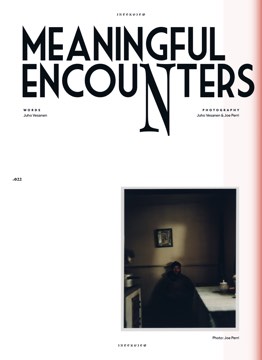
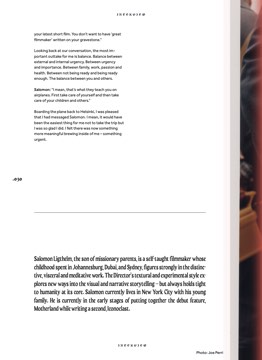
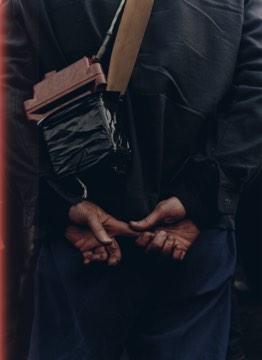
October last year, I was casually scrolling through Instagram when I saw that Salomon Ligthelm, a filmmaker who I’ve looked up to throughout my entire professional career, was about to travel to Ukraine to shoot a short film. I messaged Salomon straight away (can I come?) and was positively surprised to get an answer almost immediately. Seven days later, I found myself getting into a taxi at the Boryspil International Airport in Kiev.
I arrived at the hotel late in the afternoon and decided to walk around to get a feel of the city. The hotel was located near the Maidan square, the Independence square. A central location during the massive protests in 2014 when the Ukrainian people overthrew the president and its government that tried to tie Ukraine tighter to Russia, instead of an open relationship with the European Union. This afternoon, the square looked peaceful. People were out enjoying the sunset. I decided to head towards the city center and started walking on Khreshchatyk, the main street running through the city. Khreshchatyk was completely destroyed during the WWII by the retreating Red Army troops and rebuilt during the 1960s. I mean, these historic details were obviously not something that I actively thought about when walking in Kiev but now, amidst the Russian war against Ukraine, things have changed perspective. It feels devastating that just four months after my trip everything changed.
I had never met anyone on the production team so I was feeling a bit nervous on the eve of the first day of filming.
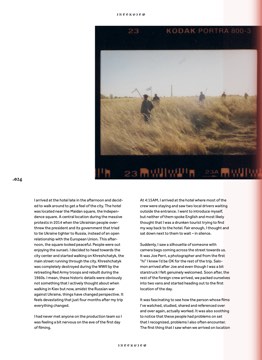
At 4:15AM, I arrived at the hotel where most of the crew were staying and saw two local drivers waiting outside the entrance. I went to introduce myself, but neither of them spoke English and most likely thought that I was a drunken tourist trying to find my way back to the hotel. Fair enough, I thought and sat down next to them to wait – in silence.
Suddenly, I saw a silhouette of someone with camera bags coming across the street towards us. It was Joe Perri, a photographer and from the first ”hi” I knew I’d be OK for the rest of the trip. Salomon arrived after Joe and even though I was a bit starstruck I felt genuinely welcomed. Soon after, the rest of the foreign crew arrived, we packed ourselves into two vans and started heading out to the first location of the day.
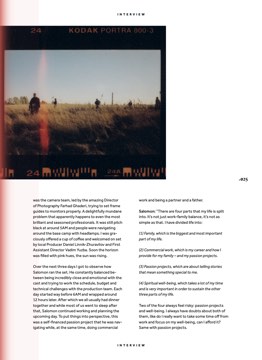
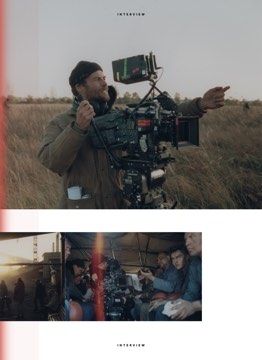
It was fascinating to see how the person whose films I’ve watched, studied, shared and referenced over and over again, actually worked. It was also soothing to notice that these people had problems on set that I recognized, problems I also often encounter. The first thing that I saw when we arrived on location was the camera team, led by the amazing Director of Photography Farhad Ghaderi, trying to set frame guides to monitors properly. A delightfully mundane problem that apparently happens to even the most brilliant and seasoned professionals. It was still pitch black at around 5AM and people were navigating around the base camp with headlamps. I was graciously offered a cup of coffee and welcomed on set by local Producer Daniel Linnik-Zhuravliov and First Assistant Director Vadim Yuzba. Soon the horizon was filled with pink hues, the sun was rising.
Over the next three days I got to observe how Salomon ran the set. He constantly balanced between being incredibly close and emotional with the cast and trying to work the schedule, budget and technical challenges with the production team. Each day started way before 6AM and wrapped around 12 hours later. After which we all usually had dinner together and while most of us went to sleep after that, Salomon continued working and planning the upcoming day. To put things into perspective, this was a self-financed passion project that he was navigating while, at the same time, doing commercial work and being a partner and a father.
Salomon: ”There are four parts that my life is split into. It’s not just work-family balance, it’s not as simple as that. I have divided life into:
(1) Family, which is the biggest and most important part of my life.
(2) Commercial work, which is my career and how I provide for my family – and my passion projects.
(3) Passion projects, which are about telling stories that mean something special to me.
(4) Spiritual well-being, which takes a lot of my time and is very important in order to sustain the other three parts of my life.
Two of the four always feel risky: passion projects and well-being. I always have doubts about both of them, like do I really want to take some time off from work and focus on my well-being, can I afford it? Same with passion projects.
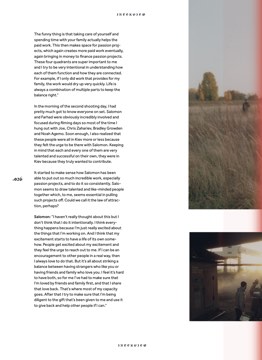
The funny thing is that taking care of yourself and spending time with your family actually helps the paid work. This then makes space for passion projects, which again creates more paid work eventually, again bringing in money to finance passion projects. These four quadrants are super important to me and I try to be very intentional in understanding how each of them function and how they are connected. For example, if I only did work that provides for my family, the work would dry up very quickly. Life is always a combination of multiple parts to keep the balance right.”
In the morning of the second shooting day, I had pretty much got to know everyone on set. Salomon and Farhad were obviously incredibly involved and focused during filming days so most of the time I hung out with Joe, Chris Zahariev, Bradley Growden and Noah Agemo. Soon enough, I also realized that these people were all in Kiev more or less because they felt the urge to be there with Salomon. Keeping in mind that each and every one of them are very talented and successful on their own, they were in Kiev because they truly wanted to contribute.
It started to make sense how Salomon has been able to put out so much incredible work, especially passion projects, and to do it so consistently. Salomon seems to draw talented and like-minded people together which, to me, seems essential in pulling such projects off. Could we call it the law of attraction, perhaps?
Salomon: ”I haven’t really thought about this but I don’t think that I do it intentionally. I think everything happens because I’m just really excited about the things that I’m working on. And I think that my excitement starts to have a life of its own somehow. People get excited about my excitement and they feel the urge to reach out to me. If I can be an encouragement to other people in a real way, then I always love to do that. But it’s all about striking a balance between having strangers who like you or having friends and family who love you. I feel it’s hard to have both, so for me I’ve had to make sure that I’m loved by friends and family first, and that I share that love back. That’s where most of my capacity goes. After that I try to make sure that I’m being diligent to the gift that’s been given to me and use it to give back and help other people if I can.”
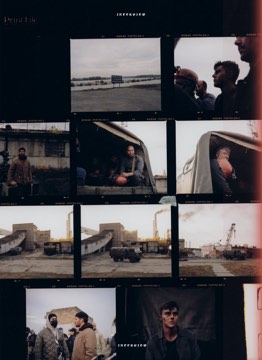
On the third shooting day, we found ourselves on a big field and everyone was preparing for the logistically biggest scene of the film. There were multiple vehicles and around 25 extras circling lead actor Chris. We were running a bit late since there were some technical issues with the cameras. The main camera was on a steadicam and the other on a tripod. At one point, while a Camera Assistant was fixing a problem on the main camera, Salomon grabbed the other one and started running around capturing portraits of the extras. He kept running back to the main camera whenever it was ready and then back to the extras between takes. He refused to let any technical difficulties cripple the production, instead pushing forward and making the most of it.
But we were still behind schedule as we headed to the final location of the day. At this point, it was interesting to observe how Salomon and the production team tried to work out what compromises had to be done, how much overtime the crew could toil – and whether he would be willing to pay for it. Salomon took it all on with absolute calmness and still had the time to chat with people in the midst of it.
Salomon: ”My parents always told me that anything is possible – but never in a purely ambitious kind of way of becoming famous or anything like that. I was encouraged to go after my dreams, but they also taught me there will be sacrifices to be made along the way. My dad asked, ‘what has God put on your heart, what’s the skill that he’s given you?’ And that I’d just have to have trust in Him to open the path and make way for me – knowing that only if I had my heart in the right place, my priorities in order, then the rest of my dreams would align. So that’s kind of the way I’ve lived and the way our family lives now. And I understand that this might sound like ‘oh so you never had struggles or worries about anything’, but that is definitely not the case. I’ve had plenty. But when I recenter myself, I’m reminded that all my struggles and problems are very temporary and they only exist on the surface. They are there to help me grow, change, evolve and mature. My trust and confidence comes from somewhere much deeper and I think that was modeled in me by my parents, has stood with me for a very long time and has helped me navigate every season of my life.”
While following Salomon on set in Kiev, I thought about the concept of everyday tasks and how most of us seem to live on the surface alone, while dreams exist somewhere deeper. This is how we fit into society – we do what is expected of us within the ready-made framework. This oddly then becomes our comfort zone, even though these everyday tasks are the things that we complain about the most. We all feel the importance of our dreams, but it’s hard to find the urgency to be able to dig them out, make them surface and pursue them.
Salomon: ”To me, there are two sides to urgency. One is the urgency from outside, where people expect you to do something or when you start feeling the fear of missing out – the FOMO-syndrome creeping in. This often includes a lot of self-doubt and other negative emotions as you compare yourself to other people who seem to be doing the next big thing or whatever. It can be crippling. The other is the urgency that moves you from within, an internal sense of what do I need to do, which comes from a much deeper question of ‘who am I?’. It’s a much more cosmic and spiritual question. As with many things, managing these urgencies comes down to balance. Balance between being able to say no to ‘big things’ that are offered to me, but that are often not the right things for me to do at that moment. That ability to discern is really important to me. The key here is to establish your own voice first and to make sure that you are ready to take on the right ‘big thing’ when it comes to you. And look, you’re never ready. You’re never ready to have a kid, you’re never ready to get married. You’re just never ready. But, you can be ready enough. And that is what I’m preparing myself to be right now with these short films. They are all training different muscles that are not yet strong and developed enough to take on the feature film that I will want to do soon. However, these stories that I’m telling right now, these short films, they’re not just purely muscle training. Each of them mean a lot to me as standalone entities, which is equally as important to me as the big picture.”
But is it possible to not let future dreams completely take over your everyday life? Can one approach big dreams piece by piece? Slowly, but with intention and discipline?
Salomon: ”Yes it’s important to follow your dreams, it’s absolutely vital. But don’t do it in a vacuum. You might have your parents to think about, them getting older. You have your wife and kids and brothers and sisters to think about. Think about your friends. Like yes, follow your dreams but be responsible. Make sure that you’re taking care of those around you since that’s the legacy you leave behind, not your latest short film. You don’t want to have ‘great filmmaker’ written on your gravestone.”
Looking back at our conversation, the most important outtake for me is balance. Balance between external and internal urgency. Between urgency and importance. Between family, work, passion and health. Between not being ready and being ready enough. The balance between you and others.
Salomon: ”I mean, that’s what they teach you on airplanes. First take care of yourself and then take care of your children and others.”
Boarding the plane back to Helsinki, I was pleased that I had messaged Salomon. I mean, it would have been the easiest thing for me not to take the trip but I was so glad I did. I felt there was now something more meaningful brewing inside of me – something urgent.
Salomon Ligthelm, the son of missionary parents, is a self-taught filmmaker whose childhood spent in Johannesburg, Dubai, and Sydney, figures strongly in the distinctive, visceral and meditative work. The Director’s textural and experimental style explores new ways into the visual and narrative storytelling – but always holds tight to humanity at its core. Salomon currently lives in New York City with his young family. He is currently in the early stages of putting together the debut feature, Motherland while writing a second, Iconoclast.
Next in Issue 003: Wandering in a dream