Interview with Vanille Verloës · Issue 003 · pp. 064–069 · 8 min read
Urgency with Vanille Verloes
- Words / Antoine Paikert
- Visuals / Vanille Verloes
This story in print
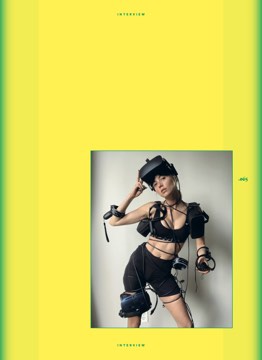
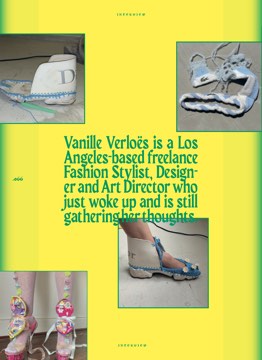
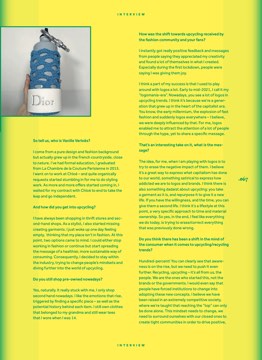
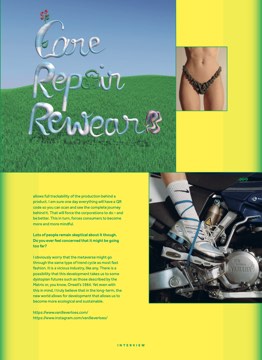
Vanille Verloës is a Los Angeles-based freelance Fashion Stylist, Designer and Art Director who just woke up and is still gathering her thoughts.
So tell us, who is Vanille Verloës?
I come from a pure design and fashion background but actually grew up in the French countryside, close to nature. I’ve had formal education, I graduated from La Chambre de la Couture Parisienne in 2015. I went on to work at Chloé – and quite organically requests started stumbling in for me to do styling work. As more and more offers started coming in, I waited for my contract with Chloé to end to take the leap and go independent.
And how did you get into upcycling?
I have always been shopping in thrift stores and second-hand shops. As a stylist, I also started missing creating garments. I just woke up one day feeling empty, thinking that my place isn’t in fashion. At this point, two options came to mind. I could either stop working in fashion or continue but start spreading the message of a healthier, more sustainable way of consuming. Consequently, I decided to stay within the industry, trying to change people’s mindsets and diving further into the world of upcycling.
Do you still shop pre-owned nowadays?
Yes, naturally. It really stuck with me, I only shop second hand nowadays. I like the emotions that rise, triggered by finding a specific piece – as well as the potential history behind each item. I still own clothes that belonged to my grandma and still wear tees that I wore when I was 14.
How was the shift towards upcycling received by the fashion community and your fans?
I instantly got really positive feedback and messages from people saying they appreciated my creativity and found a lot of themselves in what I created. Especially during the first lockdown, people were saying I was giving them joy.
I think a part of my success is that I used to play around with logos a lot. Early to mid-2021, I call it my “logomania-era”. Nowadays, you see a lot of logos in upcycling trends. I think it’s because we’re a generation that grew up in the heart of the capitalist era. You know, the early millennium, the explosion of fast fashion and suddenly logos everywhere – I believe, we were deeply influenced by that. For me, logos enabled me to attract the attention of a lot of people through the hype, yet to share a specific message.
That’s an interesting take on it, what is the message?
The idea, for me, when I am playing with logos is to try to erase the negative impact of them. I believe it’s a great way to express what capitalism has done to our world, something satirical to express how addicted we are to logos and brands. I think there is also something dadaist about upcycling: you take a garment as it is, and repurpose it to give it a new life. If you have the willingness, and the time, you can give them a second life. I think it’s a lifestyle at this point, a very specific approach to time and material ownership. So yes, in the end, I feel like everything we do today, is trying to erase/correct everything that was previously done wrong.
Do you think there has been a shift in the mind of the consumer when it comes to upcycling/recycling trends?
Hundred-percent! You can clearly see that awareness is on the rise, but we need to push it even further. Recycling, upcycling – it’s all from us, the people. We are the ones who started this, not the brands or the governments. I would even say that people have forced institutions to change into adopting these new concepts. I believe we have been raised in an extremely competitive society, where we’re taught that reaching the “top” can only be done alone. This mindset needs to change, we need to surround ourselves with our closed ones to create tight communities in order to drive positive, collectively-built change. I think the next generations are the ones that will have to reinforce this change. There are already many who are creating opposition through social media. Along with this strong, social media-built discourse, things are really starting to move. Brands are finally waking up and taking action. You can see that a lot of companies are implementing second hand options in their pieces, as well as developing new materials and technologies that are more sustainable.
We are definitely seeing brands implementing more sustainable techniques, but do you think the world of fashion has already hit a point of no return?
We have definitely reached an extreme point in terms of production. [Redacted brand name] is releasing a new collection every week. How is this even possible? Did you know that the biggest ecological impact of the whole production process is the sourcing and production of raw materials? For example, Africa as a continent is running out of water mostly due to the production of cotton. Basically, you need 2,5 liters of drinkable water to produce a tee of 250 grams of cotton. This means you need 10 liters of water to produce a kilo of cotton – and over 7 000 liters of potentially drinkable water to produce and make a pair of jeans shop-ready. Not only that, the chemicals used in garment production leave an irradicable track on the ecosystem. And when fabrics are cut, it leaves behind dust which is filled with so many chemicals that the dust will stay on Earth forever. Then, obviously, there are all the unsold clothes and the ones we throw away. Thinking about all of this, upcycling is a great way to counter these devastating processes. We need to collectively learn how to give our old clothes a new life and that we do not need to throw garments away.
What do you think should change first and foremost?
The higher levels: brands and governments should have a stronger discourse on the topic of sustainability and educate consumers. For example, every brand should use AR (Augmented Reality) to present the clothes. That would allow for consumers to see if they actually like the product before producing a mass of unsold pieces. The overall education of citizens should play a larger role. In France, we learn how to sort our waste, recycle a bit but that’s about it. There is so much more that should be done! If everyone would start upcycling and being more mindful about their consumption, we would see a big difference.
What advice would you give to someone wanting to change their consumption habits?
Honestly, just go for it! Everyone has a pair of scissors at home and the Internet is filled with sewing tutorials. Like I said previously, it is more about creating a lifestyle as recycling and upcycling can be a bit time-consuming, you need resources. However, it can be extremely social. I often work on DIY projects with friends or with my Mom and we just have a good time. There is also a meditative aspect to this way of living, where you can end up spending more time with yourself. Overall, it’s a very enriching experience! And if you can’t sew or don’t have the time, you can get it done by someone else too! In the end it’s better for the planet and you end up with pieces that are unique. To me, it really is all about balance in life, the way you are and the way you consume. We need to be living conscientiously.
Like with most people nowadays, you and I first met on social media. I discovered your work randomly but instantly knew that I needed to interview you. One thing that interests me is your involvement in Web3 and the NFT. How did that start?
When the pandemic started, it put a lot of things on hold for me. The lifestyle spent traveling daily and being on set stopped and I had to find new things to do. At this time, I started finding things like blockchain and Web3. These new concepts and the digital world allowed me to lead a nomadic lifestyle, working from anywhere from my computer without having to be physically in place. But the main reason for me to dive deep into the NFTs was to be able to make my work unique – and secure online.
What is your take on it?
To me, it is a world where I have complete creative freedom. I consider the concept of Web3 a utopia. There is something so magical about it! Being part of a group of people who all see it come together in a fairytale-like, new world. NFTs allow work to be linked to an artist’s name and add real value to it. That is extremely important for any artist, especially in today’s digital spaces.
With blockchain technology, I believe it will force companies to improve product quality. Blockchain allows full trackability of the production behind a product. I am sure one day everything will have a QR code so you can scan and see the complete journey behind it. That will force the corporations to do – and be better. This in turn, forces consumers to become more and more mindful.
Lots of people remain skeptical about it though. Do you ever feel concerned that it might be going too far?
I obviously worry that the metaverse might go through the same type of trend cycle as most fast fashion. It is a vicious industry, like any. There is a possibility that this development takes us to some dystopian futures such as those described by the Matrix or, you know, Orwell’s 1984. Yet even with this in mind, I truly believe that in the long-term, the new world allows for development that allows us to become more ecological and sustainable.
https://www.vanilleverloes.com/
https://www.instagram.com/vanilleverloes/
Next in Issue 003: Heat climbs the body