
Interview · Issue 001 · pp. 050–057 · 11 min read
Maria Korkeila
- Interview / Joni Lindroos
- Photography / Chris Vidal Tenomaa & Sofia Okkonen
- Stylist / Tuomas Laitinen
This story in print
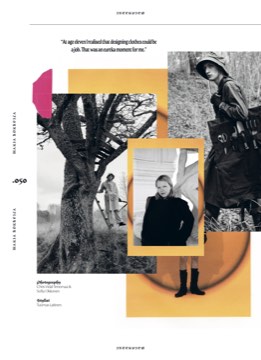
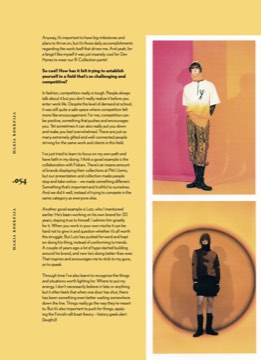
“At age eleven I realised that designing clothes could be a job. That was an eureka moment for me.”
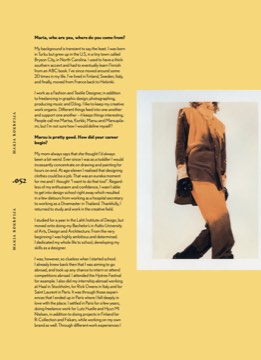
Maria Korkeila is a groundbreaking fashion and textile designer. She has worked for Saint Laurent and Rick Owens, but when she started designing her own collections everything clicked. You might have seens her hats on world famous deejays, her pants have graced Dev Hynes. Besides building her own clothing brand, she’s an active graphic designer, photographer and a DJ, producing music under the moniker Emkay. The designer’s most recent collection was in collaboration with renowned Finnish brand Fiskars, for their first-ever clothing collection.
Maria, who are you, where do you come from?
My background is transient to say the least. I was born in Turku but grew up in the U.S, in a tiny town called Bryson City, in North Carolina. I used to have a thick southern accent and had to eventually learn Finnish from an ABC book. I’ve since moved around some 20 times in my life. I’ve lived in Finland, Sweden, Italy, and finally, moved from France back to Helsinki.
I work as a Fashion and Textile Designer, in addition to freelancing in graphic design, photographing, producing music and DJing. I like to keep my creative work organic. Different things feed into one another and support one another – it keeps things interesting. People call me Martsa, Korkki, Marsu and Marsupilami, but I’m not sure how I would define myself?
Marsu is pretty good. How did your career begin?
My mom always says that she thought I’d always been a bit weird. Ever since I was as a toddler I would incessantly concentrate on drawing and painting for hours on end. At age eleven I realised that designing clothes could be a job. That was an eureka moment for me and I thought “I want to do that too!”. Regardless of my enthusiasm and confidence, I wasn’t able to get into design school right away which resulted in a few detours from working as a hospital secretary to working as a Divemaster in Thailand. Thankfully, I returned to study and work in the creative field.
I studied for a year in the Lahti Institute of Design, but moved onto doing my Bachelor’s in Aalto University of Arts, Design and Architecture. From the very beginning I was highly ambitious and determined. I dedicated my whole life to school, developing my skills as a designer.
I was, however, so clueless when I started school. I already knew back then that I was aiming to go abroad, and took up any chance to intern or attend competitions abroad. I attended the Hyéres Festival for example. I also did my internship abroad working at Haal in Stockholm, for Rick Owens in Italy and for Saint Laurent in Paris. It was through those experiences that I ended up in Paris where I fell deeply in love with the place. I settled in Paris for a few years, doing freelance work for Lutz Huelle and Hyun Mi Nielsen, in addition to doing projects in Finland for R-Collection and Fiskars, while working on my own brand as well. Through different work experiences I began to better understand what it is that I want to do and how I should pursue my goals. It was in Paris that interdisciplinarity started merging into what I do, inspired partly by a collective called The Community.
Living in Paris has been vital to me both in terms of my occupation and personal life, and I’m sure it’ll always remain a second home.
What about music?
Music has also been with me since childhood whether it was playing the guitar, piano or violin, taking singing and dancing lessons or being a general fan girl (which I still actively am). Six years ago, lying in bed, I discovered GarageBand – and that was it! The kick I had needed to stumble into DJing. Eventually, a friend booked me to play at a party with only an hour’s notice and a few minutes’ tutorial. But after that event I was suddenly being booked to play on the radio and at several events. I was really nervous in the beginning but I just went ahead because it was that much fun. And now, after years of lying on the bed in the bedroom making music, I’ve finally started sharing my own music with the world. In turn, the world inspires and encourages me to keep on doing it.
Which successes have been the most important in terms of your career?
As a designer I get the biggest sense of success when I see someone using the clothes I’ve designed. Especially when people take ownership of the clothes, making the pieces their own. That is when the clothes stop being “something by Maria” and instead, become about the person carrying them.
Obviously achievements such as making my way into the finals at Hyéres or getting the Jury’s Special Mention there, displaying my collection with R-Collection or the collaboration with Fiskars at Pitti are central, truly special. They have all given me a lot.
For me personally though, I tend to get a deeper inner sense of success from the work itself. The pleasure and excitement of getting something done, solving problems – and that moment when all falls into place. Fucking up a textile samples that end up becoming way better than I initially intended. I love that. Wasn’t it so that the iconic Fiskars’ scissors were born out of an accident? As far as I can remember, the scissors were originally meant to be black or red. Anyway, it’s important to have big milestones and plans to thrive on, but it’s those daily accomplishments regarding the work itself that drives me. And yeah, for a fangirl like myself it was just insanely cool for Dev Hynes to wear our R-Collection pants!
So cool! How has it felt trying to establish yourself in a field that’s so challenging and competitive?
In fashion, competition really is tough. People always talk about it but you don’t really realize it before you enter work life. Despite the level of demand at school, it was still quite a safe space where competition felt more like encouragement. For me, competition can be positive, something that pushes and encourages you. Yet sometimes it can also really put you down and make you feel overwhelmed. There are just so many extremely gifted and well-connected people striving for the same work and clients in this field.
I’ve just tried to learn to focus on my own path and have faith in my doing. I think a good example is the collaboration with Fiskars. There’s an insane amount of brands displaying their collections at Pitti Uomo, but our presentation and collection made people stop and take notice – we made something different. Something that’s important and truthful to ourselves. And we did it well, instead of trying to compete in the same category as everyone else.
Another good example is Lutz, who I mentioned earlier. He’s been working on his own brand for 20 years, staying true to himself. I admire him greatly for it. When you work in your own nische it can be hard not to give in and question whether it’s all worth the struggle. But Lutz has pushed forward and kept on doing his thing, instead of conforming to trends. A couple of years ago a lot of hype started building around his brand, and now he’s doing better than ever. That inspires and encourages me to stick to my guns, so to speak.
Through time I’ve also learnt to recognize the things and situations worth fighting for. Where to put my energy. I don’t necessarily believe in fate or anything but it often feels that when one door has shut, there has been something even better waiting somewhere down the line. Things really go the way they’re meant to. But it’s also important to push for things, applying the Finnish raft boat theory – history geek alert (laughs)!
Has your creative process changed as you’ve made progress in your career?
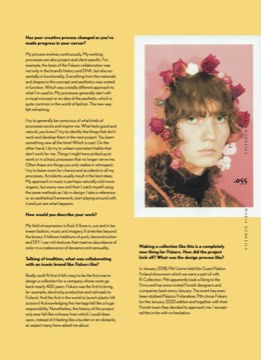
My process evolves continuously. My working processes are also project and client specific. For example, the basis of the Fiskars collaboration was not only in the brand’s history and DNA, but also essentially in functionality. Everything from the materials and shapes to the concept and aesthetics was rooted in function. Which was a totally different approach to what I’m used to. My processes generally start with a visual concept or an idea of the aesthetic, which is quite common in the world of fashion. The new way felt refreshing.
I try to generally be conscious of what kinds of processes excite and inspire me. What feels good and natural, you know? I try to identify the things that don’t work and develop them in the next project. You learn something new all the time! Which is cool. On the other hand, I do try to unlearn persistent habits that don’t work for me. Things I might have picked up at work or in school, processes that no longer serve me. Often these are things you only realise in retrospect. I try to leave room for chance and accidents in all my processes. Accidents usually result in the best ideas. My approach in music is perhaps naturally a bit more organic, but every now and then I catch myself using the same methods as I do in design: I take a reference or an aesthetical framework, start playing around with it and just see what happens.
How would you describe your work?
My field of expression is fluid. It flows in, out and in between fashion, music and imagery. It stretches beyond the binary. It follows traditions of punk, deconstruction and DIY. I use rich textures that meet an abundance of color in a coalescence of deviance and sensuality.
Talking of tradition, what was collaborating with an iconic brand like Fiskars like?
Really cool! At first it felt crazy to be the first one to design a collection for a company whose roots go back nearly 400 years. Fiskars was the first to bring, for example, electricity production and railroads to Finland. And the first in the world to launch plastic hilt scissors! Acknowledging this heritage felt like a huge responsibility. Nonetheless, the history of this project only ever felt like richness from which I could draw upon, instead of it feeling like a burden or an obstacle, an aspect many have asked me about.
Making a collection like this is a completely new thing for Fiskars. How did the project kick off? What was the design process like?
In January 2018, Pitti Uomo held the Guest Nation Finland showroom which we were a part of with R-Collection. Pitti apparently took a liking to the Finns and has since invited Finnish designers and companies back every January. The event has even been dubbed Palazzo Finlandese. Pitti chose Fiskars for the January 2020 edition and together with their Finnish team they decided to approach me. I accepted the invite with no hesitation.
I first got acquainted with Fiskars’ estates (literally, they’re the biggest private landowner in Finland), their factories and their history. We layed out a clear structure for the collection: which pieces to include and then went through what the technical requirements for the items would be. Then I started sketching. I drew a lot of inspiration from the history of Fiskars and its surroundings.
I ended up taking with me an old book I found in the attic of our summer cottage, my grandmother’s “Ihminen Pääosassa” by Ismo Hölttö. Hölttö photographed people all around Finland in the late 60s, around the same time when Fiskars’ iconic scissors were launched. Hölttö portrayed people in their own habitat, many farmers for example.
I found it interesting how little workwear had changed from that era. I then noticed that the same goes for the development of Fiskars’ tools. The heritage, tradition and DNA are clearly there and still noticeable today, at the same time when the design, technical aspects and aesthetics have been molded to suit the world of today. The tools are both rooted in tradition yet futuristic.
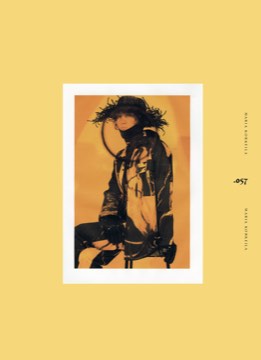
This all gave me the idea to use traditional working clothes as a reference and to bring them up-to-date with technical, functional and sustainable materials and structures. I was given more or less free reign but we still worked closely with the company.
How was it like collaborating with the brand?
I had a really good time! It’s cool to work with such an old and established Finnish company. They have no shortage of craftsmanship, know-how or nice people. It was also nice to notice that we were on the same page about making the collection: we wanted a collection that was aesthetic, high in quality yet ecological and as ethical as possible.
We used organic cotton, recycled fibres, PFC-free waterproof treatment and vegan leather. The production was all done in Europe which enabled the inspection of factories.
How long did the project take from the point of initial inspiration to the end product?
The collaboration was initiated around May 2019. Around August we really got the ball rolling. So half a year, give or take. What made it so great was that in addition to working with Fiskars, we also worked with a bunch of professionals on the presentation and production side of things. Everyone put their best foot forward and delivered on their ends. The end result is much more than the sum of its parts.
Did you feel a sense of success?
I feel like we were able to do something that’s aesthetically interesting and current in time but also very functional. Anecdotally, the collection has also spoken to a wide range of different kinds of people which feels extremely rewarding to me.
I’m very much looking forward to seeing people wear the collection!
Next in Issue 001: Aliina Kauranne