Visual essay · Issue 001 · pp. 076–081 · 3 min read
Notes from a place
- Writer / Fedja Kamari
- Photography / Fedja Kamari
This story in print
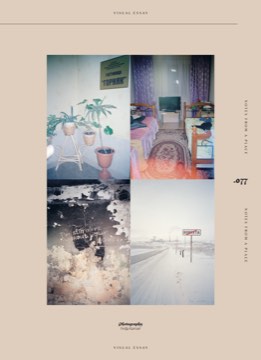
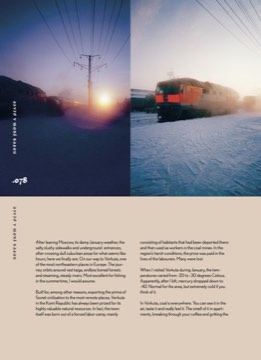
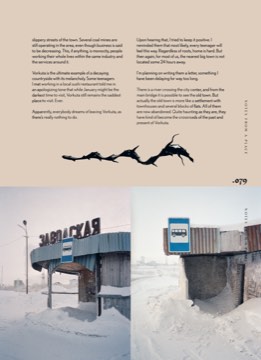
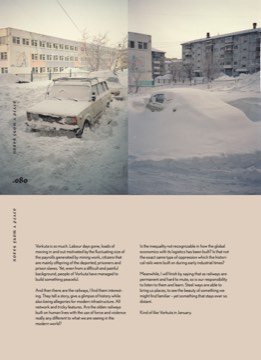
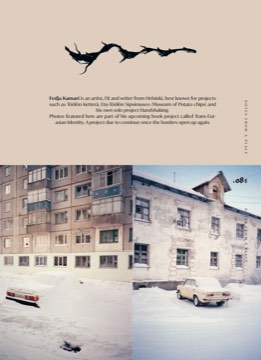
Vorkuta, Russia.
After leaving Moscow, its damp January weather, the salty slushy sidewalks and underground entrances, after crossing dull suburban areas for what seems like hours, here we finally are. On our way to Vorkuta, one of the most northeastern places in Europe. The journey orbits around vast taiga, endless boreal forests and steaming, steady rivers. Most excellent for fishing in the summertime, I would assume.
Built for, among other reasons, exporting the prime of Soviet civilisation to the most remote places, Vorkuta in the Komi Republic has always been prized for its highly valuable natural resources. In fact, the town itself was born out of a forced labor camp, mainly consisting of habitants that had been deported there and then used as workers in the coal mines. In the region’s harsh conditions, the price was paid in the lives of the labourers. Many were lost.
When I visited Vorkuta during January, the temperatures varied from -20 to -30 degrees Celsius. Apparently, after I left, mercury dropped down to -40. Normal for the area, but extremely cold if you think of it.
In Vorkuta, coal is everywhere. You can see it in the air, taste it and really feel it. The smell of it in apartments, breaking through your coffee and gritting the slippery streets of the town. Several coal mines are still operating in the area, even though business is said to be decreasing. This, if anything, is monocity, people working their whole lives within the same industry and the services around it.
Vorkuta is the ultimate example of a decaying countryside with its melancholy. Some teenagers I met working in a local sushi restaurant told me in an apologizing tone that while January might be the darkest time to visit, Vorkuta still remains the saddest place to visit. Ever.
Apparently, everybody dreams of leaving Vorkuta, as there’s really nothing to do.
Upon hearing that, I tried to keep it positive. I reminded them that most likely, every teenager will feel this way. Regardless of roots, home is hard. But then again, for most of us, the nearest big town is not located some 24 hours away.
I’m planning on writing them a letter, something I have been delaying for way too long.
There is a river crossing the city center, and from the main bridge it is possible to see the old town. But actually the old town is more like a settlement with townhouses and several blocks of flats. All of them are now abandoned. Quite haunting as they are, they have kind of become the crossroads of the past and present of Vorkuta.
Vorkuta is so much. Labour days gone, loads of moving in and out motivated by the fluctuating size of the payrolls generated by mining work, citizens that are mainly offspring of the deported, prisoners and prison slaves. Yet, even from a difficult and painful background, people of Vorkuta have managed to build something peaceful.
And then there are the railways, I find them interesting. They tell a story, give a glimpse of history while also being allegories for modern infrastructure. All network and tricky features. Are the olden railways built on human lives with the use of force and violence really any different to what we are seeing in the modern world?
Is the inequality not recognizable in how the global economics with its logistics has been built? Is that not the exact same type of oppression which the historical rails were built on during early industrial times?
Meanwhile, I will finish by saying that as railways are permanent and hard to mute, so is our responsibility to listen to them and learn. Steel ways are able to bring us places, to see the beauty of something we might find familiar – yet something that stays ever so distant.
Kind of like Vorkuta in January.
Fedja Kamari is an artist, DJ and writer from Helsinki, best known for projects such as Töölön Ketterä, Etu-Töölön Sipsimuseo (Museum of Potato chips) and his own solo project Handshaking.
Photos featured here are part of his upcoming book project called Trans-Eurasian Identity. A project due to continue once the borders open up again.
Next in Issue 001: Matti Vilho