Interview · Issue 002 · pp. 022–029 · 8 min read
The Community
- Interview / Veera Almila
- Photography / Elsa Hammarén, Aurélien Mole
This story in print
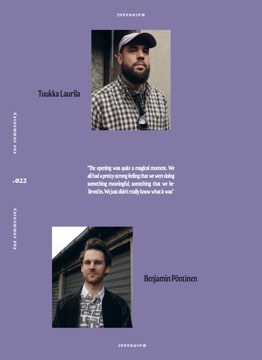
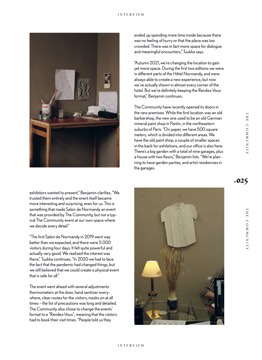
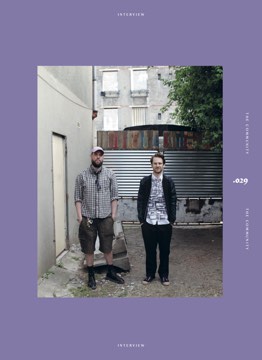
“The opening was quite a magical moment. We all had a pretty strong feeling that we were doing something meaningful, something that we believed in. We just didn’t really know what it was”
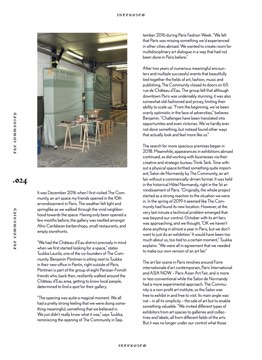
It was December 2016 when I first visited The Community, an art space my friends opened in the 10th arrondissement in Paris. The weather felt light and springlike as we walked through the vivid neighborhood towards the space. Having only been opened a few months before, the gallery was nestled amongst Afro-Caribbean barbershops, small restaurants, and empty storefronts.
“We had the Château d’Eau district precisely in mind when we first started looking for a space,” states Tuukka Laurila, one of the co-founders of The Community. Benjamin Pöntinen is sitting next to Tuukka in their new office in Pantin, right outside of Paris. Pöntinen is part of the group of eight Parisian-Finnish friends who, back then, resiliently walked around the Château d’Eau area, getting to know local people, determined to find a spot for their gallery.
“The opening was quite a magical moment. We all had a pretty strong feeling that we were doing something meaningful, something that we believed in. We just didn’t really know what it was,” says Tuukka, reminiscing the opening of The Community in September 2016 during Paris Fashion Week. “We felt that Paris was missing something we’d experienced in other cities abroad. We wanted to create room for multidisciplinary art dialogue in a way that had not been done in Paris before.”
After two years of numerous meaningful encounters and multiple successful events that beautifully tied together the fields of art, fashion, music and publishing, The Community closed its doors on 65 rue de Château d’Eau. The group felt that although downtown Paris was undeniably stunning, it was also somewhat old-fashioned and pricey, limiting their ability to scale up. “From the beginning, we’ve been overly optimistic in the face of adversities,” believes Benjamin. “Challenges have been translated into opportunities and even victories. We’ve hardly ever not done something, but instead found other ways that actually look and feel more like us.”
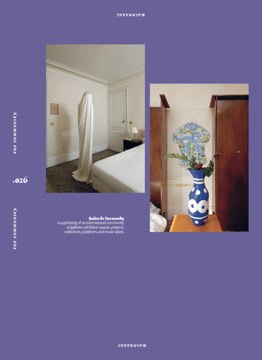
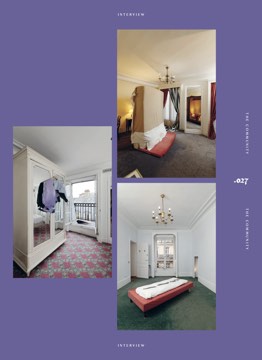
The search for more spacious premises began in 2018. Meanwhile, appearances in exhibitions abroad continued, as did working with businesses via their creative and strategic bureau Think Tank. Time without a physical space birthed something quite important; Salon de Normandy by The Community, an art fair without a commercially-driven format. It was held in the historical Hôtel Normandy, right in the 1st arrondissement of Paris. “Originally, the whole project started as a strong reaction to the situation we were in. In the spring of 2019 it seemed like The Community had found its new location. However, at the very last minute a technical problem emerged that was beyond our control. October with its art fairs was approaching, and we thought, ‘OK we haven’t done anything in almost a year in Paris, but we don’t want to just do an exhibition.’ It would have been too much about us, too tied to a certain moment,” Tuukka explains. “We were all in agreement that we needed to make our own version of an art fair.”
The art fair scene in Paris revolves around Foire internationale d’art contemporain, Paris International and ASIA NOW – Paris Asian Art Fair, and is more or less conventional while the Salon de Normandy had a more experimental approach. The Community is a non-profit art institute, so the Salon was free to exhibit in and free to visit. Its main angle was not – in all its simplicity – the sale of art but to enable something valuable. “We invited different types of exhibitors from art spaces to galleries and collectives and labels, all from different fields of the arts. But it was no longer under our control what those exhibitors wanted to present,” Benjamin clarifies, “We trusted them entirely and the event itself became more interesting and surprising, even for us. This is something that made Salon de Normandy an event that was provided by The Community, but not a typical The Community event at our own space where we decide every detail.”
“The first Salon de Normandy in 2019 went way better than we expected, and there were 5 000 visitors during four days. It felt quite powerful and actually very good. We realized the interest was there,” Tuukka continues. “In 2020 we had to face the fact that the pandemic had changed things, but we still believed that we could create a physical event that is safe for all.”
The event went ahead with several adjustments: thermometers at the door, hand sanitizer everywhere, clear routes for the visitors, masks on at all times – the list of precautions was long and detailed. The Community also chose to change the events’ format to a “Rendez-Vous”, meaning that the visitors had to book their visit times. “People told us they ended up spending more time inside because there was no feeling of hurry or that the place was too crowded. There was in fact more space for dialogue and meaningful encounters,” Tuukka says.
“Autumn 2021, we’re changing the location to gain yet more space. During the first two editions we were in different parts of the Hôtel Normandy, and were always able to create a new experience, but now we’ve actually shown in almost every corner of the hotel. But we’re definitely keeping the Rendez-Vous format,” Benjamin continues.
The Community have recently opened its doors in the new premises. While the first location was an old barbershop, the new one used to be an old German mineral paint shop in Pantin, in the northeastern suburbs of Paris. “On paper, we have 500 square meters, which is divided into different areas. We have the old paint shop, a couple of smaller spaces in the back for exhibitions, and our office is also here. There’s a big garden with a total of nine garages, plus a house with two floors,” Benjamin lists. “We’re planning to have garden parties, and artist residencies in the garages. It’s important for us to work together with local organizations, so we’re going to invite associations and schools here to do different types of workshops with us. We are now a part of the Pantin community, which will be as visible in our program as our international view of the world is.”
From the start, The Community members learned to do every single thing by themselves as there was no money to hire help. This has forced them to think differently, to be critical while finding creative ways to solve things. Currently, they are renovating the new space by themselves, with essential help from close collaborators. This way of working has become a part of The Community’s DNA. Over the past five years, The Community collective has developed a method infused with fundamental characteristics and based on an interplay of ideologies: collective and collaborative working, a nature of inclusion and participation, cross-disciplinary environments and an open-mindedness. This way repurposing, recycling, and re-thinking existing phenomena.
“We always adapt our thoughts to the physical cultural environment, wherever we are. Our new space has a lot of paint samples on some of the former showroom walls, and we want to leave some of that history here,” Tuukka clarifies. “Our first show will be a housewarming for the Community Centre. 21 artists we have worked closely with, will propose permanent artworks and installations for the space. These works will create our new home so we plan to leave things a bit raw, we won’t be doing any major renovations. This will be the beginning of our journey in Pantin, and the space will start evolving from there.”
In 2022, The Community will host a Tom of Finland Foundation exhibition. The story goes, in 2018 Benjamin, Tuukka, and another The Community member, Osma Harvilahti, were in Los Angeles. As Tom of Finland is one of the most important contemporary artists from Finland, they obviously wanted to visit the Tom of Finland Foundation in LA. “We located the foundation on Google Maps, which said the exhibition was open to the public. One of the foundation staff came to open the door, only to tell us that the visits were by appointment only. We were quite quick to explain that we were Finns who have a gallery in Paris,” Tuukka recollects, “Which is when they told us to wait.”
“Out came Durk Dehner, who was Tom’s life partner and co-founder of the foundation, and began hosting our hours long private tour through the house and garden,” Tuukka continues. “We saw where Tom used to work, where they threw parties, and where the dark room entrance was located. There was this unique energy that we’d never experienced before, people constantly coming in for lunch, to do their art projects, reside, or simply to visit because they admired Tom. We understood that what he gave to this world, his legacy, was now thriving in this house as pure energy.
“On top of that, at the end of the ’80s they started to gather a collection which not only included Tom’s works, but also the works of other artists from his community and the extended worldwide LGBTQ+ community. Nowadays, the collection is the largest collection of gay and erotic art. There were rooms that were filled with paintings from floor to ceiling. There were shelves and drawers full of artworks. Some of those pieces had never seen the light of day.”
“After a few hours with Durk on the premises, we knew we had to do an exhibition out of all this, to let other people experience what we had just experienced.”
The Community started planning their most important project up to date in collaboration with the Tom of Finland Foundation in 2019. In the spring of 2022 it is going open to the public. “The focus will lie on the Foundation. Of course there’s going to be Tom’s work but also the stories and artworks of artists that have never been documented,” Benjamin tells. “At the same time, we want to connect the exhibition to Paris and what is happening here. Alongside the exhibition there’s going to be an eight-week programme of concerts, talks, and workshops in different locations in Paris: queer bookshops and cocktail bars, for example.”
“You can’t know everything, but you can always be open to trying new things. We learn by being curious,” Benjamin reflects.
For someone, who has been lucky enough to follow The Community’s journey closely, I can guarantee you, curiosity has been leading their approach from day one.
Next in Issue 002: Ezra Miller & The Objekt A/V Live