
Essay · Issue 003 · pp. 074–077 · 4 min read
Street fishing
- Words & photography / Aapo Nikkanen
This story in print
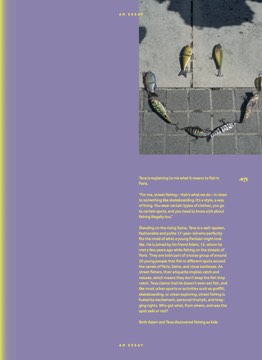
Teva is explaining to me what it means to fish in Paris.
“For me, street fishing – that’s what we do – is close to something like skateboarding. It’s a style, a way of living. You wear certain types of clothes, you go to certain spots, and you need to know a bit about fishing illegally too.”
Standing on the rising Seine, Teva is a well-spoken, fashionable and polite 17-year-old who perfectly fits the mold of what a young Parisian might look like. He is joined by his friend Adam, 15, whom he met a few years ago while fishing on the streets of Paris. They are both part of a loose group of around 20 young people that fish in different spots around the canals of Paris, Seine, and close banlieues. As street fishers, their etiquette implies catch and release, which means they don’t keep the fish they catch. Teva claims that he doesn’t even eat fish, and like most urban sports or activities such as graffiti, skateboarding, or urban exploring, street fishing is fueled by excitement, personal triumph, and bragging rights. Who got what, from where, and was the spot safe or not?
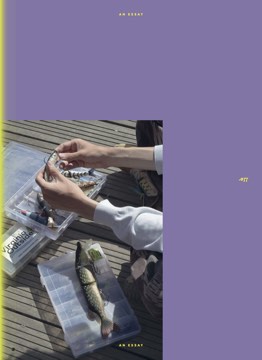
Both Adam and Teva discovered fishing as kids during their holidays in the countryside. Both started with bait fishing, and with little to no success, they continued still, bored in the vastness of the summer holidays with nothing more important to do. Once back in Paris, Teva and Adam discovered people fishing in the canal and wanted to try their luck. Teva brought his bait fishing equipment to the city and started fishing solo in the canals of Paris around 2018, first only catching a few small roaches. It all changed one day, when Teva met two older fishers who gave him some cheap rubber lures – and told him that with these he could catch a pike.
“I had no idea what a pike was, or a perch. Let alone a sander – the only fish I knew were roach and carp. This was late in autumn, just before winter so I went fishing for the whole season and didn’t get a single fish. Zero, nothing, nada. Every time I thought I had caught one it turned out to be algae. It was cold too. Yet every weekend I said to myself: ‘today I’m gonna get a fish, eventually it will happen’. I saw people on Instagram catching pikes, and that’s all I wanted. Even just a small pike, like 60 centimeters. Nothing big even! For me, it was more about the species, not the size. I persevered the whole winter, and come spring I finally caught one! A tiny pike, only about 10 centimeters long, ahah! But it was my first pike and I was so happy! That’s how I started street fishing in Paris,” Teva laughs.
Adam says he joined a fishing school organized by French Touch Fishing, a pioneering fishing shop founded by Fred Miessner, the originator of street fishing and a local legend in the city. Miessner, who passed away in 2022, was a fishing enthusiast who got impatient waiting for fishing trips outside of the city and started fishing with light equipment in Canal St. Martin. His vision of “street fishing” quickly developed into something of a lifestyle, akin to urban sports such as skateboarding or street basketball. Miessner wasn’t advocating fishing in prohibited places, but as we know, teenagers tend to navigate where the action is – whether in front of Tour d’Eiffel or in the backyards of Notre-Dame.
Listening to the stories of Adam and Teva fishing reminds me of my own youth. A time identified by skateboarding, graffiti and illegal raves. Spots, trips, sneaking into illicit places, running from the security guards and taking photos of the accomplishments of the day strike a tone that’s all too familiar. The system is rigid, and by playing along its boundaries we manage to carve out freedom. The conservative and repetitive adult structures suddenly don’t feel as inevitable as before, and for me, freedom of expression ended up becoming a full-time job.
Something I find inspiring in the mischievous fun of Teva and Adam is that it can take forms of political commentary that they themselves are blissfully unaware of. Sneaking into the gardens of Chateau de Versailles to catch huge carp with small spinning rods, and posting pictures of their trophies online feels much more inventive than, let’s say, tagging Louis XVI’s toilet or leaving without paying the bill at the restaurant of the chateau.
It makes me think that during a moment when many feel disoriented facing the incomprehensibility of the global ecological crisis, maybe what we need the most are activities that re-establish simple ways to dialogue with nature, reminding us that nature can’t be confined into spaces that are built exclusively for humans. Nature is supposed to be our ally, not a stranger.
Ultimately, no matter how hard we try to trim our gardens, clean the streets, hush away the pigeons and teach our dogs to sit, fetch, and play dead – nature still finds ways into the fortress of humanity. And while we are not looking, she gently pops out her head in the heart of it, and doesn’t give a carp.
Next in Issue 003: Caracara Collective