
Interview with Tadashi Kawamata · Issue 003 · pp. 058–063 · 9 min read
Tadashi
- Words / Landys Roimola
- Photography / Juho Vesanen
This story in print
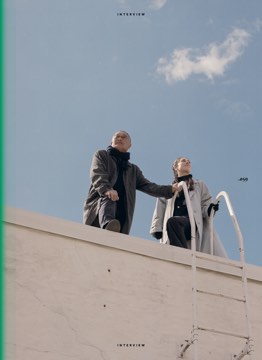
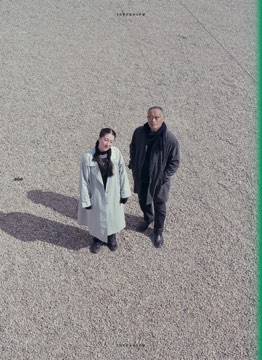
Helsinki-based Visual Artist Landys Roimola invites Japanese Artist Tadashi Kawamata into a discussion on art, safer spaces, the temporary nature of working with discarded materials and the philosophy behind Kawamata’s artistic practice.
Landys: What made you become an artist? What is the media you started off with and what was your path to these big, space invading installations?
Tadashi: I didn’t do well in school and didn’t really know what to do when I found art school. I never had any expectations or interests in going into one but once in, I studied painting. In school, I felt I wasn’t very talented with colors – but more so when working with space. Space is what made me think of installations. I loved the studios of artists’ and believed that if a space is beautiful, the art made in such a space can be beautiful too. What about you? What is your story?
Quite similar to yours; after high school I didn’t really know what to do with my life and decided to apply to art school. I wasn’t that invested in art in the beginning either, but decided to give it a chance. I actually studied graphic printmaking but already during my studies grew out of paper as a medium and after that my works have been just getting bigger and bigger.
Why did you start using discarded material in the first place?
Discarded material connects me to a place as scraps work as leads that allow me to think where the material comes from and how it was possibly used. It is also cheap, especially discarded wood.
I remember you once talking about site-specific artworks, saying ‘the creative process always begins after I’ve seen the exhibition space’. Does the material ever guide you or do you choose the materials according to what you want to make?
To begin, I need a first impression of the site and then I sketch, sometimes making models. I plan a lot beforehand. With discarded materials you never know how much you are able to get and in what type of form. When working with site-specific works, the materials are collected locally before I arrive. Here in Helsinki there were four containers full of old furniture from the recycling center. I only saw the quality upon arrival. While the working process often depends on the material, I usually draw the piece first and then source the material. On some occasions, like when working with plastic bottles collected from the sea by an organization, I am allowed to see the material first and then decide what to do with it.
The use of wood has become a hallmark in your work. Why wood?
With a background in painting, I never acquired any skills in working with stone or metal – and I don’t intend to learn any either. With my pieces, I often need a lot of people to help me. Working with wood is much easier for the assistants as well, much unlike it would be when working with stone or metal. It’s just easier to give them a screwdriver.
Working with discarded material often requires a lot of resources and time. Have you found the monotonous handling of material meditative? I mean, I have found, for example, melting plastic for hours and hours taking me to an almost ecstatic state of mind.
Yeah, I know this feeling. It’s like getting high while working. I really enjoy the feeling of getting this rush, it becomes like a ritual.
Installations this big, a bigger team is also always needed and collaborations must play a very important role in your method of working. I understood that you always assemble a team to collectively build works based on your plans. My own methods are in fact very similar and I feel I have to open my mind – and the work – to other people while the artwork is still in process. How does it feel to share your artistic process with other people?
When I lived in Tokyo, I had no atelier. I was always going to the streets and working from there, the streets were my studio. Now this, the museum, is my workshop. Here in Helsinki, the roof of Amos Rex is my atelier. It is economically very efficient as my artworks do not need transfering, they only need to purchase a ticket for me. Maybe that’s why I get invited to so many places? It is very convenient. Curators always think of budgets so even as a student working in Tokyo and living very far from Europe, I tried to be more affordable than other artists. I got to travel a lot when I was young and often stayed at curators’ houses to save them money. It became the way I work.
Your work often, if not always, disappears after the exhibition. At the same time, it will be remembered by the people who saw it and in the photos they took. Yet, even if the artwork is built again elsewhere, it will never be the same. Does the temporary nature of installations ever make you sad?
Are your artworks ever longer lasting?
No, I never get sad (laughs). It’s a continuum with no beginning or ending: I just build the work up and then take it down. I have done that over and over again for forty years now. If people really like the work, it is possible to keep it. Some of my artworks have been taken care of well. It is possible – the wooden parts can be changed even. I have made guides on how to take care of my artwork. Why is it that you work with trash and melt plastic?
For me, it started when I was a poor art student who couldn’t afford new materials so I fell in love with trash. It tells so much about us as humans and the society. If I see what you have in your trash, I will know so much about you.
Yeah yeah, it is the same with furniture! People leave marks, draw things or stick stickers on them. You can see their habits, there is a lot of history there. This is very interesting to me.
I am part of a generation that has always been concerned about the environment. By default, I feel I want to transform the cold industrial material into something organic. To me, it’s like giving back the life that was taken away from them. Maybe like giving nature a chance to strike back? Very similar to your work, mine also disappears after the exhibition is over – there is no sign of me after I am gone.
That’s interesting. What is your goal for the future, do you want to go even bigger?
Absolutely, I would love to conquer the Parliament house, to cover it completely.
That would be amazing! Please do that.
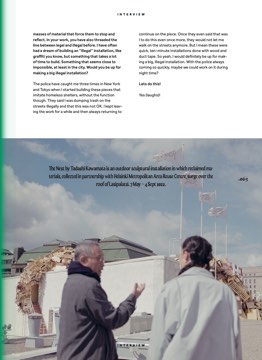
You are bringing one of your most famous works, The Nest, to Helsinki. Behind the piece lies about 25 years of investigation into the concept of nests. Nests have a strong symbolic significance to you, I believe. To me, I think of home and safety.
Where is your safe space?
Home? I don’t know, maybe in a hotel. I am like a bird of passage that moves everyday. I make a nest and then move on. Everything is always on the move for me. My home is nowhere and everywhere.
I wish I saw your installation Under the Water which builds on the 2011 tsunami in Japan. I have always been afraid of water. No one really knows why but maybe something happened in the orphanage where I was adopted from. But the way this installation looks, calm after the horrible storm, makes me feel a certain kind of peace. Sadness also, of course, because of the catastrophe, but no fear, I think. Your artworks seem to offer safe spaces to process the world around us, to examine the self and reflect on social relations. Are you aiming to create space for empathy?
Recreating a situation like a tsunami disaster felt very healing to me. I imagined a surface that is so violent but with over 2 000 people still missing, the below must be very silent. I imagined these missing people very calm under the surface. Nature is always like that; very brutal but also very still at the same time. This is very interesting to me, a natural disaster which doesn’t care about the individuals, it just is. I am going back to Japan this year to recreate the piece in the original place, and local people are not happy about this. Even if the artwork is very calm and peaceful, Japanese people in Japan don’t like to think about the tsunami, even though it happened well over ten years ago. Sometimes my work can be very provocative.
Do you aim to provoke?
I think an artist has to be provocative. We are not ones to answer questions but to raise them, to question everything. People often ask me to explain my work, but I am not offering answers – I am asking the questions.
Do you feel art should be activist?
Oh yes. Artists need to stand on the border of legal and illegal. People are always so scared and try to stay in their comfort zone. It is the artists’ work to challenge them. I am always fighting with engineers and architects because they are always overdoing the safety aspects. Nowadays, people are very afraid of public spaces due to acts of terrorism. When public spaces remain unsafe in the minds of the public, big works become dangerous. Maybe something might fall down? But this is what I believe artists need to challenge. We need to push beyond the ease and comfort.
That sounds very familiar to me as well, making people uncomfortable with these overwhelming masses of material that force them to stop and reflect. In your work, you have also threaded the line between legal and illegal before. I have often had a dream of building an “illegal” installation, like graffiti you know, but something that takes a lot of time to build. Something that seems close to impossible, at least in the city. Would you be up for making a big illegal installation?
The police have caught me three times in New York and Tokyo when I started building these pieces that imitate homeless shelters, without the function though. They said I was dumping trash on the streets illegally and that this was not OK. I kept leaving the work for a while and then always returning to continue on the piece. Once they even said that was I to do this even once more, they would not let me walk on the streets anymore. But I mean these were quick, ten-minute installations done with wood and duct tape. So yeah, I would definitely be up for making a big, illegal installation. With the police always coming so quickly, maybe we could work on it during night time?
Lets do this!
Yes (laughs)!
Next in Issue 003: Urgency with Vanille Verloes